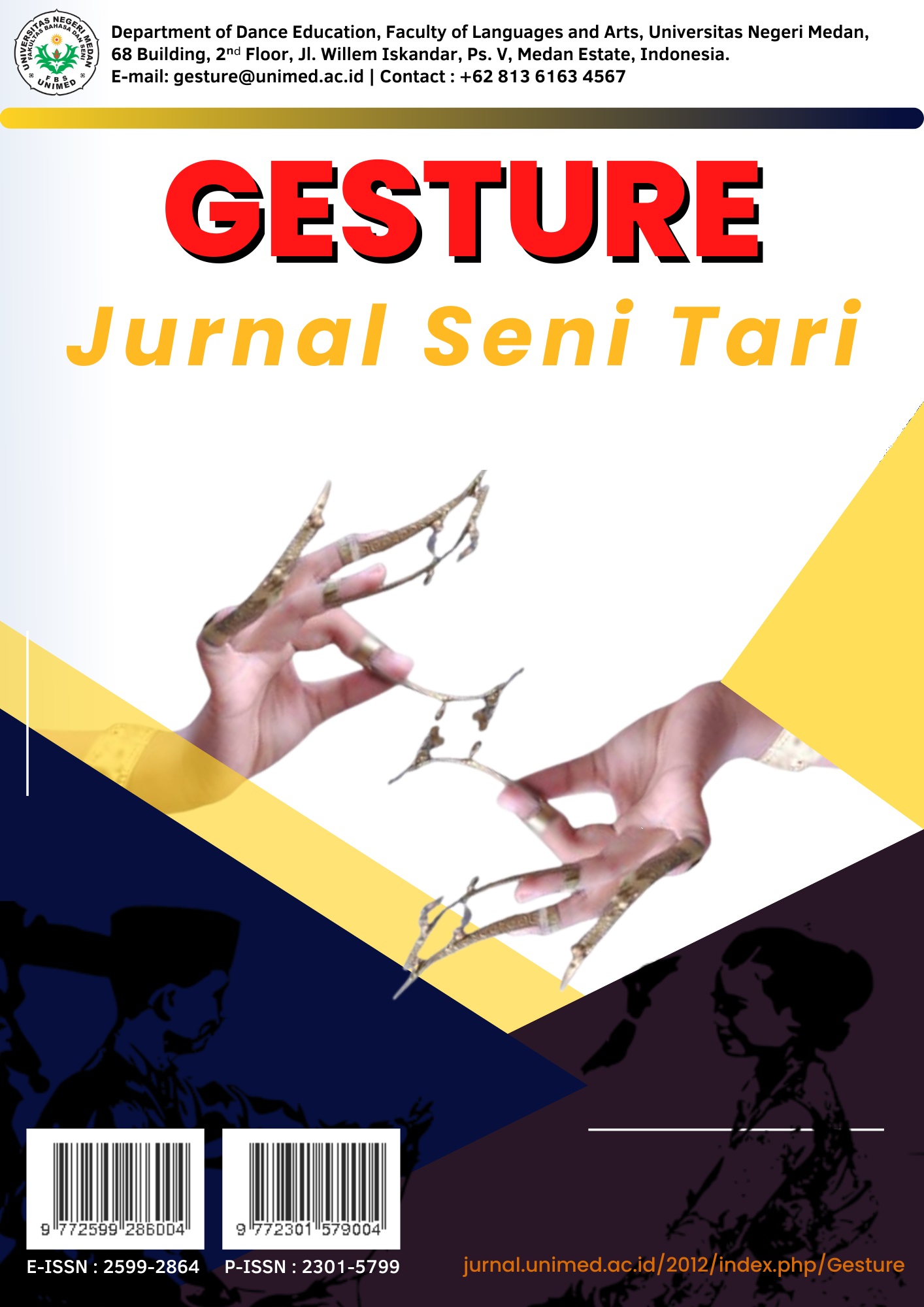
Tari Kinyah Mandau Representasi Kerukunan Suku Dayak di Kalimantan Tengah
DOI:
https://doi.org/10.24114/gjst.v15i1.72117Keywords:
Zaman Asang, Pertemuan Perdamaian Tumbang Anoi, Ritual Tari Kinyah Mandau, Transmisi BudayaAbstract
In the past, Kalimantan Island was known as a difficult-to-access region, especially during the Asang period when headhunting and slavery were common due to conflicts between Dayak tribes. Attacks were generally carried out suddenly, but the Dayak people had a tradition of preparation through the Kinyah Mandau dance, which symbolized readiness, courage, and strength in facing enemies. The tense social conditions continued even during the Dutch colonial period, until finally the Resident of Banjarmasin initiated a large meeting that gave birth to the Tumbang Anoi Peace Conference (May 22–July 24, 1894). Since this historic event, the practice of violence has ceased and the Dayak tribes are committed to living in harmony. The Kinyah Mandau dance remains preserved, but its function has transformed from a war ritual to a cultural performance. In its new form, this dance is not merely entertainment, but a symbol of harmony and a medium for passing on noble values such as courage based on truth, responsible leadership, and social solidarity. Education plays a vital role in transmitting these values to the younger generation, ensuring that the Kinyah Mandau Dance not only survives as a cultural heritage but also becomes a representation of harmony and the collective identity of the Dayak people in Central Kalimantan.
References
Andin, J. O. (2012). Nilai Kepemimpinan dalam Tari Kinyah Mandau Pada Masyarakat Suku Dayak di Kalimantan Tengah. Bandung: Universitas Pendidikan Indonesia.
Apandie, C., & Ar, E. D. (2019). Huma Betang: Identitas Moral Kultural Suku Dayak Ngaju Kalimantan Tengah. Journal of Moral and Civic Education, 3(2), 76-91. https://www.academia.edu/download/72125596/38.pdf
Arzeti, A., Aquarini, A., & Rahman, S. (2024). Komunikasi Nonverbal Pada Tari Mandau Suku Dayak Kalimantan Tengah: Nonverbal Communication In The Mandau Dance Of The Dayak Tribes Of Central Kalimantan. Restorica: Jurnal Ilmiah Ilmu Administrasi Negara dan Ilmu Komunikasi, 10(1), 13-25. https://doi.org/10.33084/restorica.v10i1.7419
Buska, W., & Prihartini, Y. (2019). Pendidikan Sebagai Proses Transmisi Sosial Budaya. Nazharat: Jurnal Kebudayaan, 25(1), 37-52. http://nazharat.fah.uinjambi.ac.id/index.php/nazharat/
article/view/12
Faiz, A., & Kurniawaty, I. (2020). Eksistensi nilai kearifan lokal kaulinan dan kakawihan barudak sebagai upaya penanaman nilai jatidiri bangsa. Jurnal Education and Development, 8(4), 27-27. https://doi.org/10.37081/ed.v8i4.2067
Forwanto, E. (2016). Nilai Tari Kinyah Mandau Dalam Kepemimpinan Pemerintahan Di Kota Palangka Raya (Studi di Dinas Kebudayaan dan Pariwisata Kota Palangka Raya). Journal Ilmu Sosial, Politik dan Pemerintahan, 5(1), 1-24. https://garuda.kemdiktisaintek.go.id/
documents/detail/1764214
Hadijaya, Y., Novita, W., & Yusdiana, E. (2025). Pendidikan sebagai proses transformasi kebudayaan. ALACRITY: Journal of Education, 276-287. https://doi.org/10.52121/alacrity.v5i1.645
Halim, A., Basyid, A., & Prihananto. (2021). Religious Identity Transformation: Cultural Interbreeding Between Dayak Indigenous Culture and Islam. Journal of Indonesian Islam, 15(1), 171–192. https://doi.org/10.15642/JIIS.2021.15.1.171-192
Ilyas, U., & Ode Murima La Ode Alumu, W. (2019). Integralisasi Budaya Dalam Sistem Pendidikan Nasional. Foramadiahi: Jurnal Kajian Pendidikan Keislaman, 11(2), 173–184. https://web.archive.org/web/20210814184014id_/http://journal.iain-ternate.ac.id/index.php/
foramadiahi/article/download/202/178
Info Itah. (2017, November). Documentary - Dayak Siang (1929). Retrieved 06/09/2024 from https://www.youtube.com/watch?v=2QJCe9-PNas
Miles, M. B., Huberman, A. M., & Saldana, J. (2014). Qualitative Data Analysis A Methods Sourcebook (Third Edition). United States Of America: Arizona State University.
Noer, M. U., & Nurbaizura, P. (2016). The Meaning Of Mandau And Sumpit As Weapon Dayak’s Tribe (A Semiotic Approach). Tamaddun, 15(2), 89-98. https://doi.org/10.33096/tamaddun.v15i2.61
Nugraheni, E. Y., & Safarina, V. (2018). Makna Tari Kinyah Mandau Hatue Suku Dayak Kabupaten Kapuas, Kalimantan Tengah. Jurnal BioKultur VII, 7(1), 35-53. https://scholar.google.com/scholar?cluster=2767990649156525785&hl=en&oi=scholarr
Rico, R., Susanto, D., Fatimah, S., & Adawiyah, M. (2024). Peran Tari Mandau Suku Dayak Dalam Komunikasi Budaya Di Era Modern: The Role Of The Dayak Mandau Dance In Cultural Communication In The Modern Era. Anterior Jurnal, 23(2), 96-105. https://doi.org/10.33084/anterior.v23i2.6979
Rochmat, S. (2018). TRANSFORMATIVE EDUCATION AS A DIALECTIC OF INDONESIAN CULTURE AND MODERN CULTURE. Jurnal Cakrawala Pendidikan, 37(3), 366-377. https://doi.org/10.21831/cp.v38i3.21513
Septriarti, S. W. (2017). Sosiologi dan Antropologi Pendidikan. (Shendy Amalia, Ed.) (1st ed.). Yogyakarta: UNY Press. http://staffnew.uny.ac.id/upload/132326892/pendidikan/Sosio
%20Antro%20Pend_Buku.pdf
Siyok, D. (2024). Perang dan Perbudakan di Tanah Dayak: Latar Belakang Pertemuan Tumbang Anoi 1894. Palangka Raya: Sinar Bagawan Khatulistiwa.
Siyok, D. (2025a). Manusia Sungai Dayak Kecil: Narasi Tentang Penghuni Kapuas Murung Abad ke-19 Berdasarkan Catatan Schwaner. Palangka Raya: Sinar Bagawan Khatulistiwa.
Siyok, D. (2025b). Orang Barido Abad XIX: Narasi Tentang Penghuni Batang Barito Berdasarkan Catatan Para Penjelajah Mula-Mula. Palangka Raya: Sinar Bagawan Khatulistiwa.
Sugiyono. (2012). Metode Penelitian Kuantitatif, Kualitatif, dan R&D. Bandung: Alfabeta.
Sulistyawati, D., & Suwarjiya, S. (2025). Nilai Budaya Dalam Tari Kinyah Mandau Pada Suku Dayak Ngaju Di Komunitas Tarantang Petak Balanga Palangkaraya Kalimantan Tengah. Educurio: Education Curiosity Учредители: Yayasan Pendidikan Tanggui Baimbaian, 3(2), 341-348. https://qjurnal.my.id/index.php/educurio
Syaikhu, Hamdi, F., Ahmad, S., Ihsan, R. N., & Husain, M. Z. (2023). The Maqashid Sharia Construction On Inheritance In Dayak Ngaju Customs Within The Tumbang Anoi Agreement. El-Mashlahah, 13(2), 181–202. https://doi.org/10.23971/el-mashlahah.v13i2.7375
Downloads
Published
Issue
Section
License
Copyright (c) 2026 Aldia Wulandari, Tris Sofia Wartina, Tifan Muhammad Amirulloh

This work is licensed under a Creative Commons Attribution-ShareAlike 4.0 International License.
Authors published with the Gesture: Jurnal Seni Tari agree to the following terms:
- Authors retain copyright and grant the journal the right of first publication with the work simultaneously licensed under a Creative Commons Attribution License (CC BY-SA 4.0) that allows others to share the work with an acknowledgment of the work's authorship and initial publication in this journal.
- Authors are able to enter into separate, additional contractual arrangements for the non-exclusive distribution of the journal's published version of the work (e.g., post it to an institutional repository or publish it in a book), with an acknowledgment of its initial publication in this journal.
- Authors are permitted and encouraged to post their work online (e.g., in institutional repositories or on their website) prior to and during the submission process, as it can lead to productive exchanges, as well as earlier and greater citation of published work. (See The Effect of Open Access)