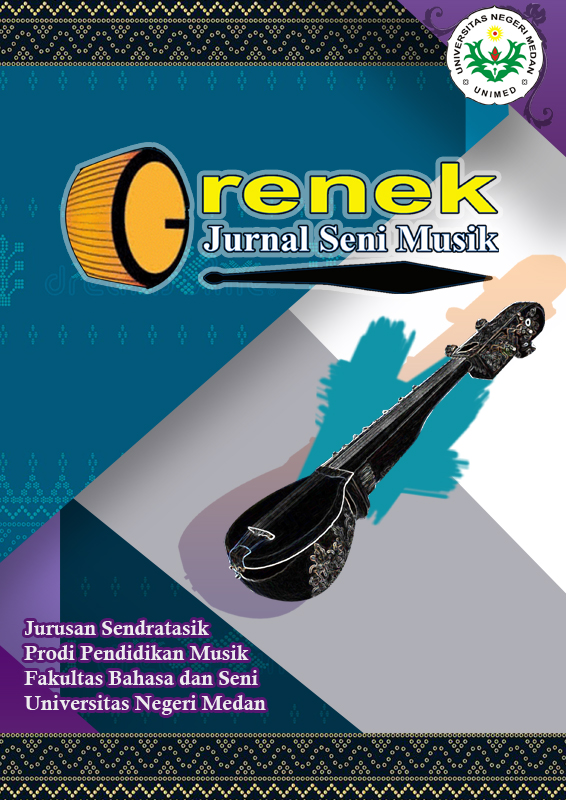
Exploring selected Traditional and Contemporary Repertoires of Malay Gamelan on the Keromong
DOI:
https://doi.org/10.24114/grenek.v14i2.68296Keywords:
Malay Gamelan, keromong, performance technique, constructivist learning, traditional music, contemporary compositionAbstract
This study examines the performance techniques of the keromong, a key melodic instrument in the Malay gamelan ensemble, focusing on both traditional and modern repertoires. Despite its central role, systematic documentation of keromong techniques remains limited, mainly because traditional teaching methods are mostly transmitted orally. Guided by constructivist learning theory, this research uses a qualitative approach, combining performance observation, semi-structured interviews, audiovisual analysis, and reflective journaling. The study explores three core techniques introduced by the late Adiguru Bob Khalil - Irama Satu (Simultaneous Rhythm), Irama Dua (Alternating Rhythm), and Irama Bertingkah (Interlocking Rhythm) and demonstrates how they are applied in both classical pieces (Timang Burung) and new compositions (Overture Maharajawana, Maharajawana, and Nafas). These techniques, integrated with the researcher’s interpretive choices, such as dynamic playing/ hitting, expressive hand gestures, and controlled breathing, enhance the emotional and visual aspects of performance. The findings show that traditional techniques, while rooted in heritage, can be effectively adapted for contemporary compositions, enriching musical interpretation and expression. This study contributes to the ongoing discussion of Malay Gamelan pedagogy by proposing a structured, accessible teaching model that complements oral traditions and provides visual or written guidance for learners. It highlights the potential of performance-based research to preserve cultural heritage while fostering innovation.
References
Amin, J. M., Abidin, M. Z. H. Z., & Noh, A. M. M. (2023). Signifikasi Beduk Sebagai Instrumen Komunikasi Tradisional Masyarakat Melayu. Jurnal'Ulwan, 8(3), 257-275. https://unimel.edu.my/journal/
index.php/JULWAN/article/view/1470/1166
Creswell, J. W., & Poth, C. N. (2018). Qualitative inquiry and research design: Choosing among five approaches (4th ed.). London: SAGE Publications.
Fosnot, C. T. (2013). Constructivism: Theory, perspectives, and practice (2nd ed.). New York: Teachers College Press.
Matusky, P., & Tan, S. B. (2017). The music of Malaysia: The classical, folk, and syncretic traditions (2nd ed.). Routledge. https://doi.org/10.4324/9781315223025
Mohd Anis Md. Nor (1985). Struktulisme: Satu tinjauan multidisplin. Kertas kerja seminar ijazah tinggi, Jabatan Pengajian Melayu, Universiti Malaya, bil 4. https://www.scribd.com/doc/289535990/Gamelan-Melayu-pdf
Mohd Shah, S., & Poheng, J. J. (2021). The Changing Landscape of the Malay Gamelan and its Implications on Music Education in Malaysia. Environment-Behaviour Proceedings Journal, 6(SI5), 137–141. https://doi.org/10.21834/ebpj.v6iSI5.2939
Nik Mustapha, Nik Mohd. Salleh & Mohd Ghazali Abdullah. (2011). Alat muzik tradisional dalam masyarakat melayu di Malaysia / Nik Mustapha Nik Mohd. Salleh. Jabatan Kebudayaan dan Kesenian Negara (JKKN).
Rahayu, S. (2009). Bothekan Karawitan II: GARAP. Surakata: Program Pascasarjana ISI Surakata Kerjasama Press.
Shively, J. (2006). A constructivist view of music education: Perspectives for deep learning: The New Handbook of Research on Music Teaching and Learning. London: Oxford University Press.
Teuku U. I., Teuku, I., & Marzelan, S. (2021). Malay gamelan: Playing techniques of the keromong and gambang. International Journal of Creative Industries, 3(8), 1–12. https://doi.org/10.35631/ijcrei.38001
Downloads
Published
Issue
Section
License
Copyright (c) 2025 Amira Farhana Binti Ahmad Hamidi, Huey Yi Wong

This work is licensed under a Creative Commons Attribution-ShareAlike 4.0 International License.
Authors published with the Grenek: Jurnal Seni Musik agree to the following terms:
- Authors retain copyright and grant the journal the right of first publication with the work simultaneously licensed under a Creative Commons Attribution License (CC BY-SA 4.0) that allows others to share the work with an acknowledgment of the work's authorship and initial publication in this journal.
- Authors are able to enter into separate, additional contractual arrangements for the non-exclusive distribution of the journal's published version of the work (e.g., post it to an institutional repository or publish it in a book), with an acknowledgment of its initial publication in this journal.
- Authors are permitted and encouraged to post their work online (e.g., in institutional repositories or on their website) prior to and during the submission process, as it can lead to productive exchanges, as well as earlier and greater citation of published work. (See The Effect of Open Access)