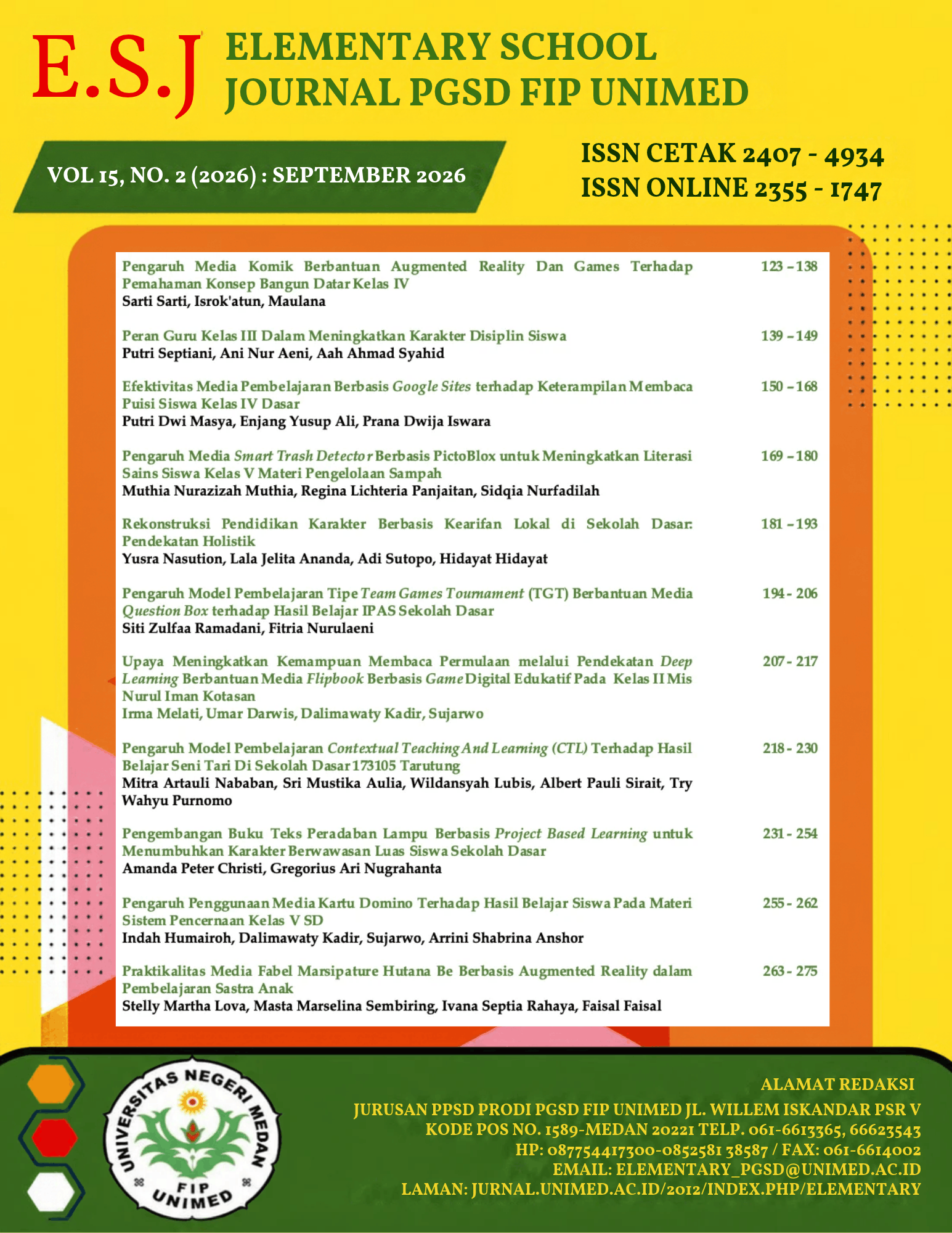
Praktikalitas Media Fabel Marsipature Hutana Be Berbasis Augmented Reality dalam Pembelajaran Sastra Anak
DOI:
https://doi.org/10.24114/2xyjrb29Keywords:
Augmented Reality, kearifan lokal, Marsipature Hutana Be, pembelajaran sastra anak, praktikalitasAbstract
Penelitian ini bertujuan untuk menganalisis tingkat praktikalitas media Fabel Marsipature Hutana Be berbasis Augmented Reality dalam pembelajaran sastra anak. Penelitian menggunakan metode Research and Development (R&D) dengan model ADDIE (Analysis, Design, Development, Implementation, and Evaluation), dengan fokus pada uji praktikalitas pada tahap Implementation. Uji terbatas melibatkan 8 mahasiswa Program Studi Pendidikan Guru Sekolah Dasar (PGSD) Semester IV yang menggunakan media dalam simulasi microteaching pada mata kuliah Pembelajaran Bahasa dan Sastra Indonesia SD. Data dikumpulkan melalui angket respons yang terdiri atas 20 item dengan skala Likert 1-5 dan mencakup enam aspek, yaitu kemudahan penggunaan, kualitas tampilan dan interaksi, kesesuaian dengan pembelajaran, daya tarik dan motivasi, kebermanfaatan, serta keterlaksanaan dan potensi penggunaan. Data dianalisis secara deskriptif kuantitatif melalui perhitungan persentase skor pada setiap aspek dan keseluruhan. Hasil penelitian menunjukkan bahwa media memperoleh skor 652 dari skor maksimal 800 atau 81,50%, sehingga termasuk kategori Sangat Praktis. Capaian tertinggi terdapat pada aspek Daya Tarik dan Motivasi serta Kebermanfaatan, masing-masing sebesar 83,33%, sedangkan aspek Keterlaksanaan dan Potensi Penggunaan memperoleh capaian terendah sebesar 77,50%. Hasil tersebut menunjukkan bahwa media Fabel Marsipature Hutana Be berbasis Augmented Reality praktis digunakan dalam pembelajaran sastra anak dan memiliki potensi untuk mendukung pengalaman pembelajaran yang menarik, kontekstual, dan berbasis kearifan lokal.
Downloads
References
Aji, I. A. B., & Pujiastuti, P. (2022). Development of natural science supplement books based on local wisdom in integrative thematic learning in the elementary schools. Jurnal Prima Edukasia, 10(1), 82–95. https://doi.org/10.21831/jpe.v10i1.40173
Aydoğdu, F. (2022). Augmented reality for preschool children: An experience with educational contents. British Journal of Educational Technology, 53(2), 326–348. https://doi.org/10.1111/bjet.13168
Cai, Y., Pan, Z., & Liu, M. (2022). Augmented reality technology in language learning: A meta-analysis. Journal of Computer Assisted Learning, 38(4), 929–945. https://doi.org/10.1111/jcal.12661
Chang, H.-Y., Binali, T., Liang, J.-C., Chiou, G.-L., Cheng, K.-H., Lee, S. W.-Y., & Tsai, C.-C. (2022). Ten years of augmented reality in education: A meta-analysis of (quasi-) experimental studies to investigate the impact. Computers & Education, 191, 104641. https://doi.org/10.1016/j.compedu.2022.104641
Chen, C.-C., Chen, H.-R., & Wang, T.-Y. (2022). Creative situated augmented reality learning for astronomy curricula. Educational Technology & Society, 25(2), 148–162. https://doi.org/10.30191/ETS.202204_25(2).001
Drljević, N., Botički, I., & Wong, L.-H. (2022). Investigating the different facets of student engagement during augmented reality use in primary school. British Journal of Educational Technology, 53, 1361–1388. https://doi.org/10.1111/bjet.13197
Gopalan, V., Abubakar, J. A., & Zulkifli, A. N. (2023). Systematic literature review on critical success factors in implementing augmented reality for science learning environment (2006–2021). Education and Information Technologies, 28, 11613–11640. https://doi.org/10.1007/s10639-023-11613-y
Herb, A., & Betts, D. (2022). Queering the book club: Empathy development through young adult literature in Australian discussion groups. Children’s Literature in Education, 55, 432–448. https://doi.org/10.1007/s10583-022-09512-w
Hermansson, C., & Olin-Scheller, C. (2022). Across textual landscapes: The role of affect during digital reading encounters. Children’s Literature in Education, 53, 327–342. https://doi.org/10.1007/s10583-022-09502-y
Kao, G. Y.-M., & Ruan, C.-A. (2022). Designing and evaluating a high interactive augmented reality system for programming learning. Computers in Human Behavior, 132, 107245. https://doi.org/10.1016/j.chb.2022.107245
Laila, A., Budiningsih, C. A., & Syamsi, K. (2021). Textbooks based on local wisdom to improve reading and writing skills of elementary school students. International Journal of Evaluation and Research in Education, 10(3), 886–892.
Law, E. L.-C., & Heintz, M. (2021). Augmented reality applications for K-12 education: A systematic review from the usability and user experience perspective. International Journal of Child-Computer Interaction, 30, 100321. https://doi.org/10.1016/j.ijcci.2021.100321
Lin, Y., & Yu, Z. (2023). A meta-analysis of the effects of augmented reality technologies in interactive learning environments (2012–2022). Computer Applications in Engineering Education, 31(4), 1111–1131. https://doi.org/10.1002/cae.22628
Marksa, S., et al. (2023). Pedagogical design in education using augmented reality: A systematic review. Interactive Learning Environments, 32(8), 4219–4236. https://doi.org/10.1080/10494820.2023.2195445
Nikou, S. A. (2024). Factors influencing student teachers’ intention to use mobile augmented reality in primary science teaching. Education and Information Technologies, 29(12), 15353–15374. https://doi.org/10.1007/s10639-024-12481-w
O'Connor, Y., & Mahony, C. (2023). Exploring the impact of augmented reality on student academic self-efficacy in higher education. Computers in Human Behavior, 149, 107963. https://doi.org/10.1016/j.chb.2023.107963
Ramli, R. Z., Ashaari, N. S., Noor, S. F. M., Noor, M., Yadegaridehkordi, E., Abd Majid, N. A., Dahlan, H. A., & Abdul Wahab, A. N. (2024). Designing a mobile learning application model by integrating augmented reality and game elements to improve student learning experience. Education and Information Technologies, 29(2), 1981–2008.
Ramli, R. Z., et al. (2023). Augmented reality: A systematic review between usability and learning experience. Interactive Learning Environments, 32(10), 6250–6266. https://doi.org/10.1080/10494820.2023.2255230
Sakr, A., & Abdullah, T. (2024). Virtual, augmented reality and learning analytics impact on learners, and educators: A systematic review. Education and Information Technologies, 29, 19913–19962. https://doi.org/10.1007/s10639-024-12602-5
Seno, U., Narimo, S., Fuadi, D., Minsih, & Widyasari, C. (2022). Implementation of local wisdom based learning in realizing Pancasila student profiles in elementary schools. Jurnal Ilmiah Sekolah Dasar, 6(4).
Shadiev, R., & Liang, Q. (2024). A review of research on AR-supported language learning. Innovation in Language Learning and Teaching, 18(1), 78–100. https://doi.org/10.1080/17501229.2023.2229804
Şimşek, B., & Direkçi, B. (2023). The effects of augmented reality storybooks on student's reading comprehension. British Journal of Educational Technology, 54(3), 754–772. https://doi.org/10.1111/bjet.13293
Udiyana, I. G., & Arnyana, I. B. P. (2022). Balinese local wisdom oriented digital teaching materials to improve cultural literacy of grade V elementary school students. Journal for Lesson and Learning Studies, 5(2), 236–243. https://doi.org/10.23887/jlls.v5i2.52411
Wang, Y., et al. (2024). How virtual reality, augmented reality and mixed reality facilitate teacher education: A systematic review. Journal of Computer Assisted Learning. https://doi.org/10.1111/jcal.12949
Downloads
Published
Issue
Section
License
Copyright (c) 2026 Stelly Martha Lova

This work is licensed under a Creative Commons Attribution 4.0 International License.

Elementary School Journal PGSD FIP UNIMED is licensed under a Creative Commons Attribution 4.0 International License.
ESJ : Elementary School Journal PGSD FIP UNIMED by PGSD Universitas Negeri Medan. p-ISSN : 2407-4934 | e-ISSN : 2355-1747



1.png)