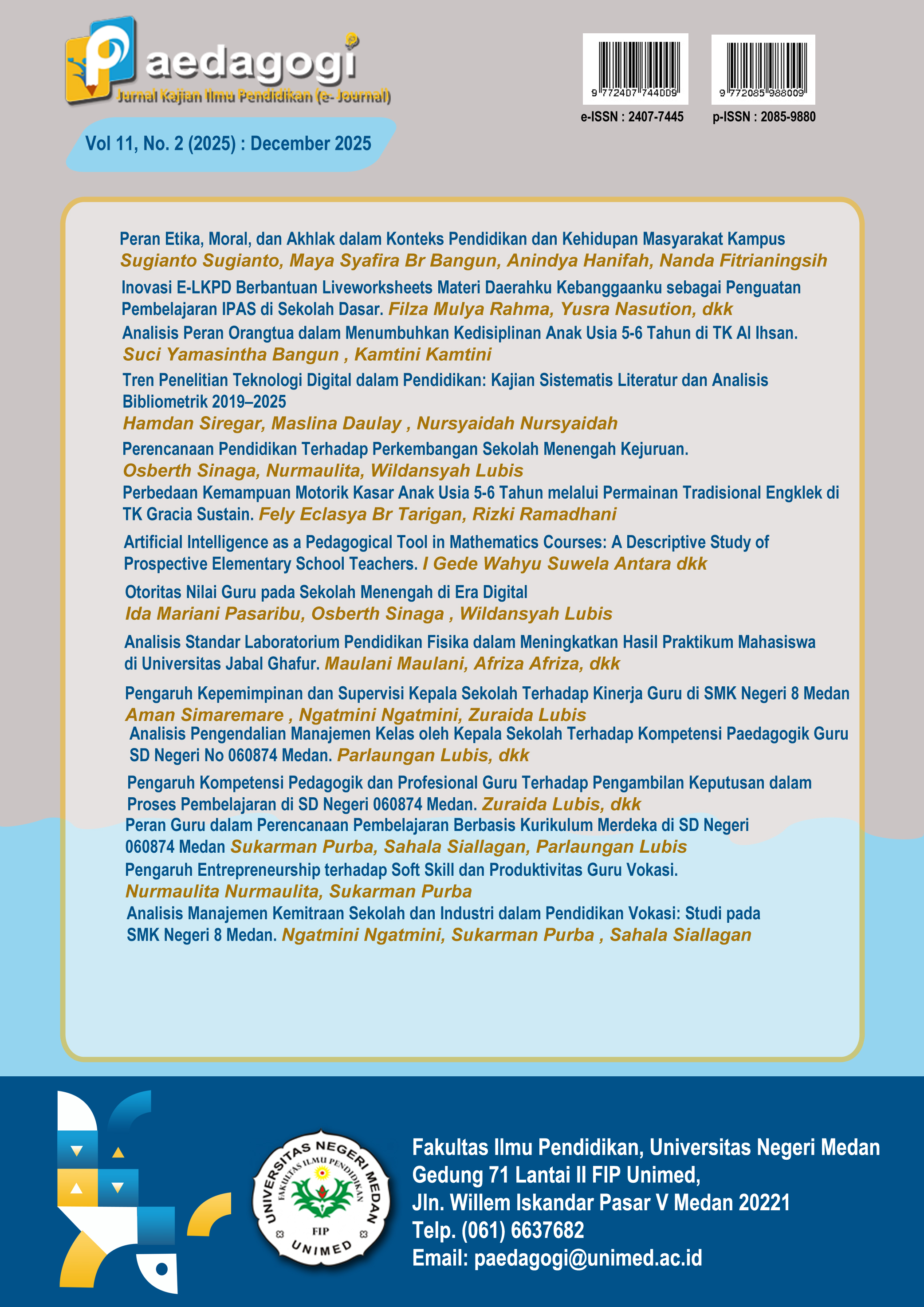
Perencanaan Pendidikan Terhadap Perkembangan Sekolah Menengah Kejuruan
DOI:
https://doi.org/10.24114/paedagogi.v11i2.69262Keywords:
Filsafat Perencanaan Pendidikan, Model Perencanaan Pendidikan, Pendekatan Perencanaan PendidikanAbstract
This article aims to analyze educational planning in the development of vocational schools, particularly vocational high schools (SMK). Educational planning is a fundamental aspect of national development, aiming not only to produce academic competencies but also to develop character, creativity, and adaptability in learners. Vocational education at Vocational High Schools (SMK) plays a strategic role in preparing skilled labor aligned with the needs of business and industry. However, challenges in graduate absorption necessitate innovative and adaptive educational planning. Learning models such as Teaching Factory (TeFa), strengthening cooperation with MSMEs, and instilling entrepreneurship are crucial steps. Philosophical foundations, comprehensive planning theories, along with progressive and humanistic educational approaches provide the main framework. Implementation of competency-based curricula, enhancement of qualified educators, industry-standard facilities, project and work-based learning methods, and close collaboration with business and industry are key to successful vocational education and producing graduates ready for work and global competitiveness.
References
Arifudin, M., Sholeha, F. Z., & Umami, L. F. (2021). Planning (Perencanaan) Dalam Manajemen Pendidikan Islam. MA'ALIM: Jurnal Pendidikan Islam, 2(02), 162-183. https://doi.org/10.21154/maalim.v2i2.3720
Banurea, R. D. U., Simanjuntak, R. E., Siagian, R., & Turnip, H. (2023). Perencanaan pendidikan. Jurnal Pendidikan Sosial dan Humaniora, 2(1), 88-99. https://publisherqu.com/index.php/pediaqu/article/view/52
Fatimah, S. (2018). Merekonstruksi pembelajaran pendidikan agama islam dan budi pekerti di sekolah negeri studi kasus sma n 14 yogyakarta. el-Tarbawi, 11(1). https://journal.uii.ac.id/Tarbawi/article/download/12122/8896/26634
Hermawan, N. (2025). Membangun Mindset Kewirausahaan Inklusif: Strategi Pendidikan Vokasi dalam Menjawab Kesenjangan Sosial dan Ekonomi. Action Research Journal Indonesia (ARJI), 7(3), 2064-2089. https://doi.org/10.61227/arji.v7i3.503
Hsv-UNDIP. (2022). Sekolah Vokasi UNDIP Terapkan Project Based Learning untuk Perkokoh Kompetensi Lulusan. Sekolah Vokasi UNDIP Website. https://vokasi.undip.ac.id/sekolah-vokasi-undip-terapkan-project-based-learning-untuk-perkokoh-kompetensi-lulusan/
Humas Mendiktisaintek. (2024). Mendiktisaintek Dorong Perguruan Tinggi Kembangkan Berbagai Skema Kemitraan untuk Dukung Peningkatan Kualitas UMKM. Kemdiktisaintek. https://kemdiktisaintek.go.id/kabar-dikti/mendiktisaintek-dorong-perguruan-tinggi-kembangkan-berbagai-skema-kemitraan-untuk-dukung-peningkatan-kualitas-umkm/
Itjen Dikdasmen. (2024). Mengenal TEFA (Teaching Factory): Panduan Pengembangan dan Pelaksanaan Model Pembelajaran Inovatif di SMK. Inspektorat Jenderal Kementerian Pendidikan Dasar dan Menengah Republik Indonesia. https://itjen.dikdasmen.go.id/web/mengenal-tefa-teaching-factory-panduan-pengembangan-dan-pelaksanaan-model-pembelajaran-inovatif-di-smk/
Murdani & Umar. (2022). FILOSOFI PERENCANAAN PENDIDIKAN. Makalah: IAIN Manado. https://www.academia.edu/92338756/FILOSOFI_PERENCANAAN_PENDIDIKAN
Nasrudin, E., Yasha, S. A., & Supriadi, U. (2025). Implikasi Pandangan Filsafat Pragmatisme John Dewey Terhadap Praktik Pendidikan Serta Relevansinya Dengan Merdeka Belajar Kampus Merdeka. Jurnal Kajian Ilmiah, 25(1), 9-24. https://doi.org/10.31599/nts9v257
Pusat Standar dan Kebijakan Pendidikan. (2024). Peningkatan Teaching Factory (TeFa) sebagai Dukungan Pembelajaran Berbasis Industri di SMK. https://pskp.kemendikdasmen.go.id/analisis-kebijakan/detail/538
Puspitasari, I. N. N. (2018). Pendidikan Pragmatis-Progresif Islamic International School (IIS) Kediri di Era Industri 4.0. Realita: Jurnal Penelitian Dan Kebudayaan Islam, 16(2), 1-19. https://jurnallppm.iainkediri.ac.id/index.php/realita/article/download/108/103
Putera, Z. F., & Shofiah, N. (2021). Model kurikulum kompetensi berpikir pada pembelajaran Bahasa Indonesia di Perguruan Tinggi Vokasi. Jurnal Pendidikan Bahasa Dan Sastra Indonesia Metalingua, 6(1), 29-36. https://doi.org/10.21107/metalingua.v6i1.10094
Rachman. (2024). Perencanaan Dan Pengembangan Teaching Factory (TeFa) Smart Apps Creator (SAC) Multimedia Builder SMK. INOSI. https://inosi.co.id/perencanaan-dan-pengembangan-teaching-factory-tefa-smart-apps-creator-sac-multimedia-builder-smk/
Saputri, D. R., Pratiwi, T. R., Palupi, L. A., Pratiwi, I. I., Purwandari, D. R., & Masturi, M. (2023). Filosofi Pendidikan Indonesia Dalam Perspektif Ki Hadjar Dewantara Dan Relevansinya Dengan Pendidikan Profesi Guru. In Prosiding Seminar Nasional Fisika (Vol. 35, pp. 346-360). https://proceeding.unnes.ac.id/psnk/article/view/3102
Wasitohadi, W. (2012). Pragmatisme, humanisme dan implikasinya bagi dunia pendidikan di Indonesia. Satya Widya, 28(2), 175-190. https://doi.org/10.24246/j.sw.2012.v28.i2.p175-190
Downloads
Published
Issue
Section
License
Copyright (c) 2025 Osberth Sinaga, Nurmaulita, Wildansyah Lubis

This work is licensed under a Creative Commons Attribution-ShareAlike 4.0 International License.
Authors published with the Paedagogi: Jurnal Kajian Ilmu Pendidikan (e-journal) agree to the following terms:
- Authors retain copyright and grant the journal the right of first publication with the work simultaneously licensed under a Creative Commons Attribution License (CC BY-SA 4.0) that allows others to share the work with an acknowledgment of the work's authorship and initial publication in this journal.
- Authors are able to enter into separate, additional contractual arrangements for the non-exclusive distribution of the journal's published version of the work (e.g., post it to an institutional repository or publish it in a book), with an acknowledgment of its initial publication in this journal.
- Authors are permitted and encouraged to post their work online (e.g., in institutional repositories or on their website) prior to and during the submission process, as it can lead to productive exchanges, as well as earlier and greater citation of published work. (See The Effect of Open Access)