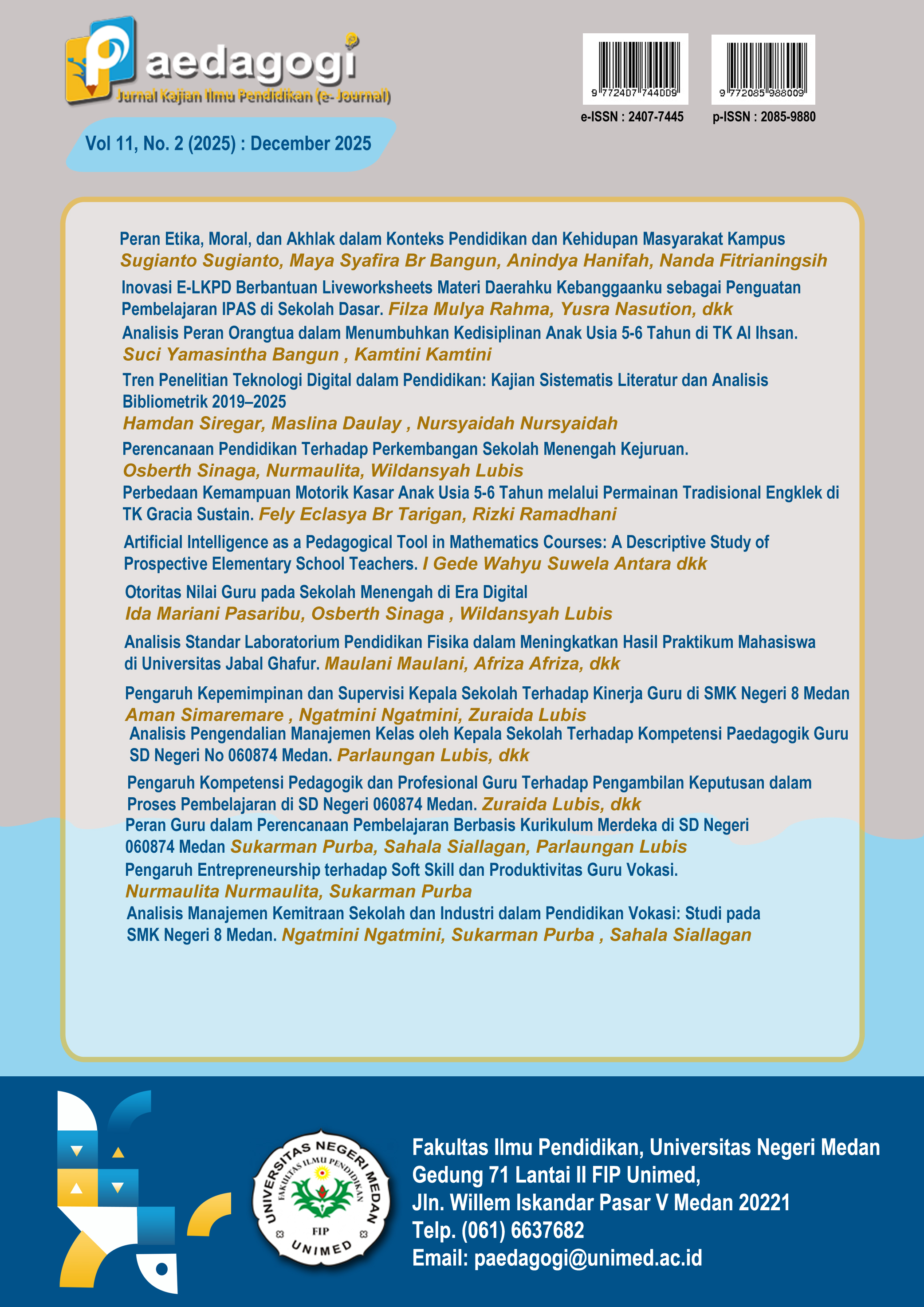
Otoritas Nilai Guru pada Sekolah Menengah di Era Digital
DOI:
https://doi.org/10.24114/paedagogi.v11i2.69571Keywords:
Otoritas Nilai Guru, Filsafat Manajemen Pendidikan, Literasi Moral DigitalAbstract
This research aims to analyse the transformation of teachers’ values of authority in the digital era, characterised by shifts in social interaction patterns and the spread of media culture. As technology and digital communities help students construct their own value horizons, teachers are no longer the sole sources of moral legitimacy. This study investigates how the Dialogic Value Authority Model can strengthen teachers’ moral legitimacy by focusing on five key dimensions: relationality, dialogic legitimacy, sustainability of moral dialogue, digital ethics, and the design of hybrid learning spaces. The findings indicate that teachers who internalise these five dimensions are able to restore students’ moral trust through equitable relationships and reflective communication. Practically, the study recommends reforming teacher training policies toward digital moral literacy and establishing digital ethics policies in schools. Theoretically, it integrates the concept of reflective authority into the philosophy of educational management, positioning teachers as moral facilitators and value managers. In this age of computers and the internet, the proposed model offers a new approach to managing education that is moral, inclusive, and contextually responsive.
References
Bush, T., Bell, L., & Middlewood, D. (2019). Educational management: Theory, practice, and ethics. London: Sage Publications.
Bush, T., Bell, L., & Middlewood, D. (2019). Moral leadership and ethical management in education: A reappraisal in digital contexts. Educational Management Administration & Leadership, 47(6), 945–962. London: Sage Publications. https://doi.org/10.1177/1741143219858423
Campbell, J. (2024). The moral implications of mobile device bans in schools: A philosophical perspective. Journal of Educational Ethics, 39(2), 211–227. New York: Routledge. https://doi.org/10.1080/02667363.2024.0123456
Creswell, J. W., & Poth, C. N. (2018). Qualitative inquiry and the ethics of reflexivity in education research. Educational Researcher, 47(3), 153–166. Thousand Oaks, CA: Sage Publications. https://doi.org/10.3102/0013189X17726832
Fullan, M. (2020). Leading in a culture of change revisited: Moral purpose in digital schools. Journal of Educational Change, 21(4), 457–474. Dordrecht: Springer. https://doi.org/10.1007/s10833-020-09377-1
Fullan, M. (2020). The new meaning of educational change (5th ed.). New York: Teachers College Press.
Habermas, J. (1984). The theory of communicative action and education reform. Philosophy of Education Journal, 12(1), 45–66. Boston: Beacon Press.
Habermas, J. (1984). The theory of communicative action, Vol. 1: Reason and the rationalization of society. Boston: Beacon Press.
Hietanen, L., Laru, J., & Järvelä, S. (2023). Shared inquiry and reflective dialogue in digital learning communities. Scandinavian Journal of Educational Research, 67(1), 88–104. Oslo: Taylor & Francis. https://doi.org/10.1080/00313831.2022.2043985
Kobayashi, K. (2022). Digital moral reflection and trust in Japanese high schools. Asia Pacific Journal of Education, 42(3), 325–340. Singapore: Springer Nature. https://doi.org/10.1080/02188791.2022.2040083
Manca, S., & Ranieri, M. (2023). Digital ethics and the moral dimension of teachers’ professional identity. Computers & Education, 195(1), 104–121. Amsterdam: Elsevier. https://doi.org/10.1016/j.compedu.2022.104676
Miles, M. B., Huberman, A. M., & Saldaña, J. (2018). Qualitative data analysis: A methods sourcebook (4th ed.). Thousand Oaks, CA: Sage Publications.
Nucci, L., Krettenauer, T., & Thompson, R. (2024). Dialogical approaches in moral and character education: Implications for the digital era. Journal of Moral Education, 53(1), 15–33. London: Taylor & Francis. https://doi.org/10.1080/03057240.2024.1234567
Raharjo, S., Nugroho, A., & Hidayat, R. (2022). Online learning and the shifting authority of teachers in Indonesia during COVID-19. Indonesian Journal of Educational Research, 5(2), 67–81. Yogyakarta: Universitas Negeri Yogyakarta Press. https://doi.org/10.21009/ijer.052.07
Scheler, M. (1921). Formalism in ethics and non-formal ethics of values. Berlin: Niemeyer Verlag.
Sergiovanni, T. J. (2020). Moral leadership: Getting to the heart of school improvement. San Francisco, CA: Jossey-Bass.
Tang, Y. (2024). Dialogical assessment and moral reasoning in digital classrooms. Journal of Digital Education and Society, 16(2), 115–132. Hong Kong: Education Press. https://doi.org/10.1080/26938415.2024.1239876
Tilaar, H. A. R. (2002). Perubahan sosial dan pendidikan: Pengantar pedagogik transformatif untuk Indonesia. Jakarta: Grasindo.
Trevisan, O., Bellini, F., & Moretti, C. (2024). Continuous professional learning for teachers in digital environments: Moral and epistemic implications. Teaching and Teacher Education, 135(4), 104–129. Amsterdam: Elsevier. https://doi.org/10.1016/j.tate.2023.104179
Wegerif, R., & Major, L. (2024). The dialogic mind: Education, technology, and meaning. Cambridge: Cambridge University Press.
Downloads
Published
Issue
Section
License
Copyright (c) 2025 Ida Mariani Pasaribu, Osberth Sinaga , Wildansyah Lubis

This work is licensed under a Creative Commons Attribution-ShareAlike 4.0 International License.
Authors published with the Paedagogi: Jurnal Kajian Ilmu Pendidikan (e-journal) agree to the following terms:
- Authors retain copyright and grant the journal the right of first publication with the work simultaneously licensed under a Creative Commons Attribution License (CC BY-SA 4.0) that allows others to share the work with an acknowledgment of the work's authorship and initial publication in this journal.
- Authors are able to enter into separate, additional contractual arrangements for the non-exclusive distribution of the journal's published version of the work (e.g., post it to an institutional repository or publish it in a book), with an acknowledgment of its initial publication in this journal.
- Authors are permitted and encouraged to post their work online (e.g., in institutional repositories or on their website) prior to and during the submission process, as it can lead to productive exchanges, as well as earlier and greater citation of published work. (See The Effect of Open Access)