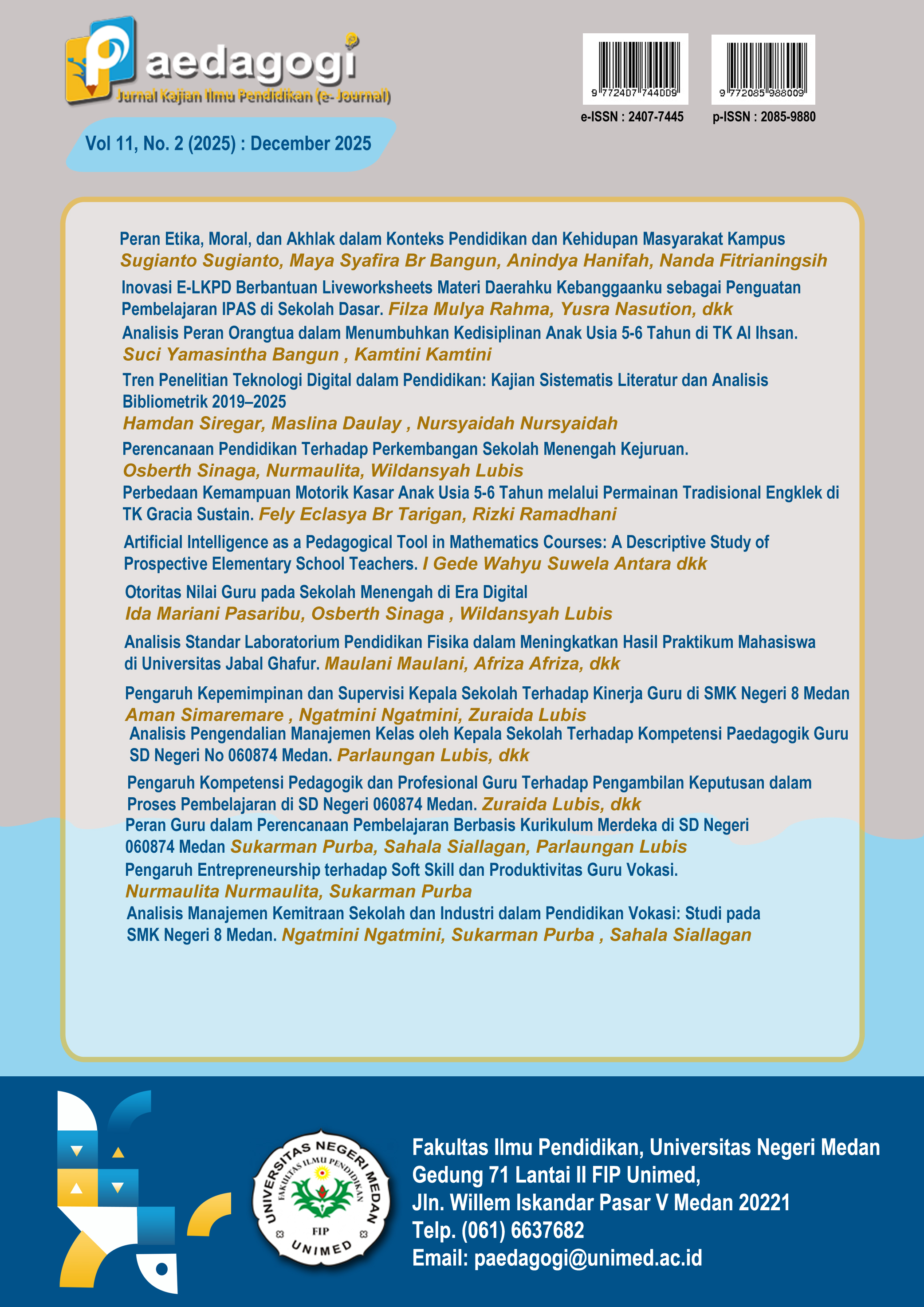
Analisis Standar Laboratorium Pendidikan Fisika dalam Meningkatkan Hasil Praktikum Mahasiswa di Universitas Jabal Ghafur
DOI:
https://doi.org/10.24114/paedagogi.v11i2.69819Keywords:
Standar Laboratorium, Praktikum Fisika, Manajemen LaboratoriumAbstract
Physics laboratories play a crucial role in supporting the practicum activities of physics education students. This study aims to analyzethe standards of the physics laboratory at Jabal Ghafur University and their impact on the quality of students practicum. The research used a qualitativeapproach with the CIPP (context, input, process, product) evaluation model. Data were collected throughobservation, interviews, questionnaires, and documentation, with a sample of fifth-semester students actively involved in practicum. The results indicate that theoverall laboratory management is in the adequate category, with an average score of 2.15 and a satisfaction rate of 53.7%. The readiness of laboratory asistants/lecturers scored the highest, while the adequacy of laboratory standars received the lowest score. The study concludes that although the laboratory meets minimum satndars, comprehensive improvements are still needed, particularly in facilities and the effectiveness of practicum activities to support student learning outcomes.
References
Ardiansyah. (2020). Pengaruh Pelayanan Perpustakaan Terhadap Minat Baca Siswa Sekolah Dasar Teja Barat 1 Pemakasan. Tibanndaru:Jurnal Ilmu Perpustakaan dan Informasi, 4(2), 17-30. https://dx.doi.org/10.30742/tb.v4i2.988
Azzurel, L . A., Dinda, T. A., Seka, A., F. (2023). Analisis Standar Laboratorium Fisika dalam Meningkatkan Hasil Praktikum Siswa di SMAN 1 Banyuwangi. Paedagogi: Jurnal Kajian Ilmu Pendidikan, 9(2), 279-290. https://doi.org/10.24114/paedagogi.v9i2.52667
Daryanto. (2018). Manajemen Laboratorium Sekolah. Surakarta: Gava Media.
Dewi, D. A., Sastrawidana, D. K., Wiratini, N., M. (2019). Analisis Pengelolaan Alat dan Bahan Praktikum pada Laboratorium Kima di SMA Negeri 1 Tampaksiring. Jurnal Pendidikan Kimia Undiksha, 3(1), 37-42. https://doi.org/10.23887/jjpk.v3i1.21162
Hardani, Helmina, A., Jumari, U., Utami, E. F., Istiqomah, R. R., Fardana, R. A., Sukmana, D.J., N. (2020). Buku Metode penelitian Kualitatif. Yogyakarta:Pustaka Ilmu.
Imanda, R., Fakhrah. (2023). Pedoman Pengelolaan Laboratorium. Aceh Utara: Pt Raja Grafindo Persada.
Istinganah, F. Y., Syam, M., Zulkarnaen. (2021). Pemanfaatan Laboratorium Fisika dan Kontribusinya dalam Pembelajaran Fisika, Studi Kasus di SMA Negeri 1 Sendawar dan SMA Negeri 1Lingga Bigung Kabupaten Kutai Barat. Jurnal Literasi Pendidikan Fisika (JLPF), 2(1), 23-33. https://doi.org/10.30872/jlpf.v2i1.406
Junaidi, N. S., Hatika, R. G., Dahlia, D., Hasibuan, U. (2023). Analisis Pengelolaan Laboratorium Fisika di MAN 1 Rokon Hulu. JPF (Jurnal Pendidikan Fisika), 11(1), 76-82. https://doi.org/10.24252/jpf.v11i1.34834
Kayal, G. G., & Khalife, M. R. (2025). Optimizing quality assurance practices: exploring the Saudi Arabian perspective and their influence on internasional accreditation and rankings. Cogent Education. 12(1), 2482455. https://doi.org/10.1080/2331186X.2025.2482455
Kurnia, M., Moh, S. (2020). Pengembangan Laboratorium Virtual Sebagai Media Pembelajaran: Peluang dan Tantangan. JUTEK: Jurnal Sains dan Teknologi, 3(2), 77-83. https://doi.org/10.31764/justek.vXiY.ZZZ
Meri, Q., Kimia, w. I., Fitria, H., Putra, A., Y. (2024). Science Laboratory Management in Learning. Journal of Social Work and Science Education, 5(2), 404-416. https://doi.org/10.52690/jswse.v5i2.761
Muttaqin., Ismalizah, N., Mufarrihah, A. T., Sartika., Harareta., S. Dinurrohmah, S., & Sulaeman, N. F. (20230. Analisis Keamanan Percobaan Fisika Pada Laboratorium Fisika di SMA Kota Samarinda. Jurnal Literasi Pendidikan Fisika. 4(1), 1-8. https://jurnal.fkip.unmul.ac.id/index.php/JLPF
Parman, H., Siddhpura, M., & Siddhpura, A. (20240. Enhancing Student Engagement: Strategies for Effective Online Laboratory Instruction. EDULEARN21 Proceedings, 3654-3666. https://doi.org/10.21125/edulearn.2024.0945
Ramdani, E. M. (2020). Penerapan Problem Based Learning Berbantuan Virtual Lab PhET pada Pembelajaran Fisika Guna Meningkatkan Pemahaman Konsep Siswa SMA: Literatur Riview. JPFT (Jurnal Pendidikan Fisika Tadulako Online), 8(1), 19-30. https://doi.org/10.22487/jpft.v8i1.1191
Sabdha, D., A. Safira, N., W. khaerina, D., A. & Nurul, F., S. (2024). Mengeksporasi Dampak Ketersediaan Peralatan pada Pelaksanaan Praktikum Fisika di Laboratorium SMA. Jurnal literasi Pendidikan Fisika. 5(1), 49-58. http://jurnal.fkip.unmul.ac.id/index.php/JLPF
Silvia, S., Aryanti, F., I. (2022). Analisi Penerapan Manajemen Laboratorium Prodi Teknik Kimia Polimer Politeknik STMI Jakarta. Jurnal Teknologi dan Manajemen, 20(2), 103-108. https://doi.org/10.52330/jtm.v20i2.55
Sulistiyowati, W. (2017). Konsep Umum Populasi dan Sampel dalam Penelitian. Jurnal Kajian Islam Kontemporer, 14(1), 15-31. https://jurnal.stainmajene,ac.id/index.php/jkik/article/view/180
Susamti, R., Herlina, L., Sasi, F., A. (2021). Teknik Pengelolaan Laboratorium. Yogyakarta: Cahaya Harapan.
Weng, M., Lim. (2025). What is Qualitative Research? An Overview and Guidelines. Australasian Marketing Journal, 33(2), 199-229. https://doi.org/10.1177/14413582241264619
Yuyun, S., Bambang, B. H., Moch, R., Achmad, S., P. (2023). Implementasi Laboratorium Virtual menggunakan Model Evaluasi CIIP. Jurnal Penelitian. 8(2), 131-139. https://doi.org/10.46491/jp.v8i2.1499
Downloads
Published
Issue
Section
License
Copyright (c) 2025 Maulani Maulani, Afriza Afriza, Aida Rahmy , Muksalmina Muksalmina, Mulia Rahmi

This work is licensed under a Creative Commons Attribution-ShareAlike 4.0 International License.
Authors published with the Paedagogi: Jurnal Kajian Ilmu Pendidikan (e-journal) agree to the following terms:
- Authors retain copyright and grant the journal the right of first publication with the work simultaneously licensed under a Creative Commons Attribution License (CC BY-SA 4.0) that allows others to share the work with an acknowledgment of the work's authorship and initial publication in this journal.
- Authors are able to enter into separate, additional contractual arrangements for the non-exclusive distribution of the journal's published version of the work (e.g., post it to an institutional repository or publish it in a book), with an acknowledgment of its initial publication in this journal.
- Authors are permitted and encouraged to post their work online (e.g., in institutional repositories or on their website) prior to and during the submission process, as it can lead to productive exchanges, as well as earlier and greater citation of published work. (See The Effect of Open Access)