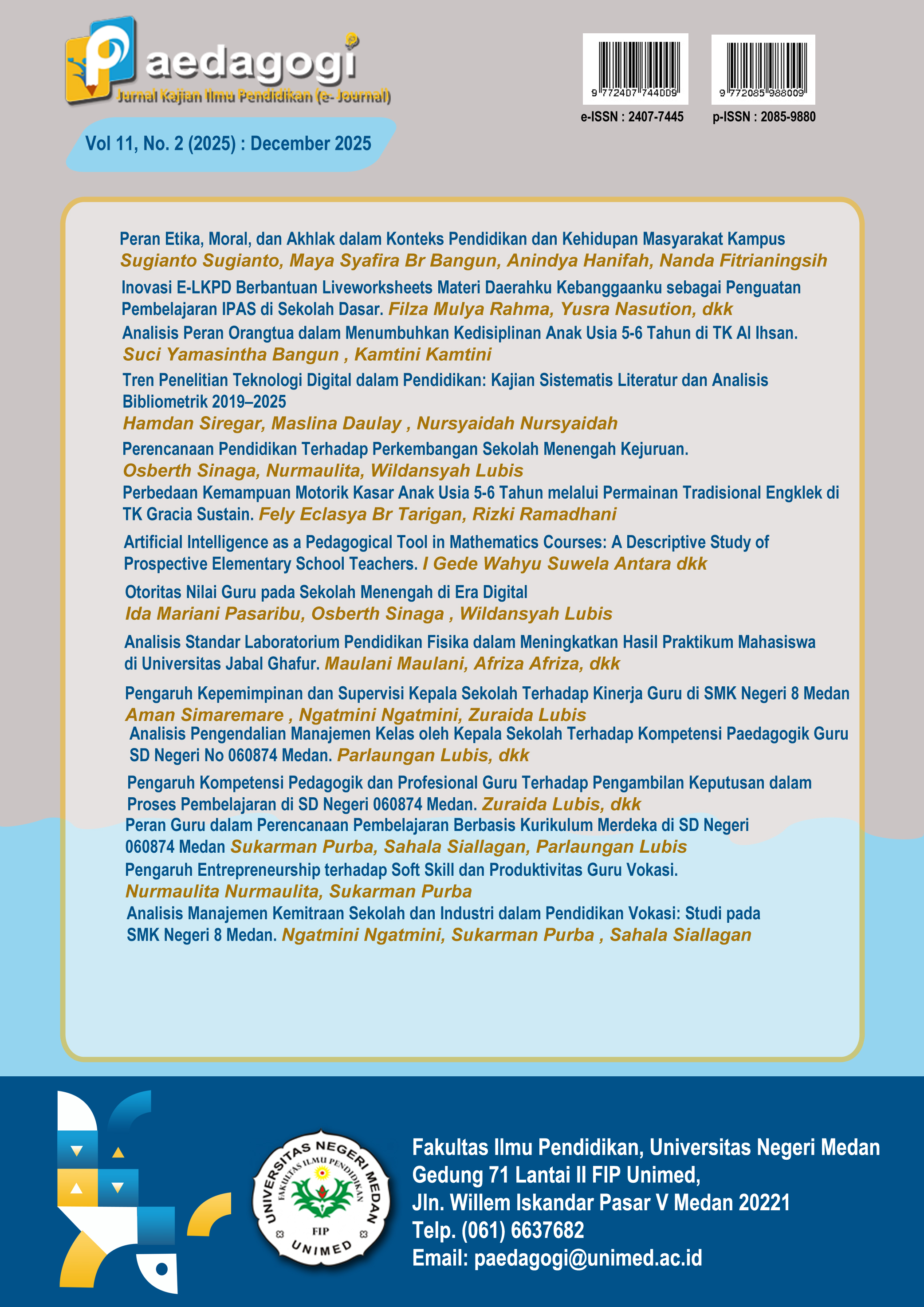
Analisis Pengendalian Manajemen Kelas oleh Kepala Sekolah Terhadap Kompetensi Paedagogik Guru SD Negeri No 060874 Medan
DOI:
https://doi.org/10.24114/paedagogi.v11i2.69975Keywords:
Pengendalian, Manajemen Kelas, Kepala SekolahAbstract
Classroom management control is one of the principal’s key functions in ensuring that the teaching and learning process runs effectively and meets educational standards. In practice, however, supervision is often carried out in an unsystematic manner, which affects the optimal development of teachers’ pedagogical competence. This study aims to analyze the forms of classroom management control implemented by the school principal and its impact on teachers’ pedagogical competence at SD Negeri 060874 Medan. A qualitative research approach with a case study design was employed. Data were collected through classroom observations, in-depth interviews with the principal and teachers, and document analysis of supervision records. The findings reveal that the principal’s classroom management control includes lesson observations, inspection of teaching documents, and provision of feedback. Nevertheless, such control tends to be administrative in nature and lacks strong instructional guidance, which limits its effectiveness in enhancing teachers’ ability to design learning activities, implement active strategies, and conduct authentic assessments. The study concludes that the effectiveness of classroom management control depends heavily on the consistency of supervision, the quality of feedback, and the follow-up of professional development activities. The implications highlight the need for principals to strengthen instructional supervision through coaching and reflective practices to foster the optimal growth of teachers’ pedagogical competence.
References
Creemers, B. P. M. (1994). The Effective Classroom. London: Cassell.
Denzin, N. K., & Lincoln, Y. S. (2009). The Sage Handbook of Qualitative Research. Thousand Oaks, CA: Sage Publications
Dick, W., & Carey, L. (2005). The Systematic Design of Instruction. Boston: Allyn and Bacon.
Direktorat Pendidikan Menengah Umum. (1999). Panduan Manajemen Sekolah. Jakarta: Departemen Pendidikan Nasional.
Fajar, C. (2022). Supervisi Pendidikan: Sebuah Inovasi Pengembangan Profesionalisme Guru. Jawa Timur: Klik Media.
Handoko, T. H. (1995). Manajemen. Yogyakarta: BPFE.
Hasanah, E., Maryani, I., Suyatno, & Gestiardi, R. (2023). Model Pembelajaran Diferensiasi Berbasis Digital di Sekolah. Yogyakarta: K-Media.
Kivunja, C. (2014). Innovative pedagogies in higher education to become effective teachers of 21st century skills: Unpacking the learning and innovations skills domain of the new learning paradigm. International journal of higher education, 3(4), 37-48. http://dx.doi.org/10.5430/ijhe.v3n4p37
Lestari, I., & Ilhami, A. (2022). Penerapan model project based learning untuk meningkatkan keterampilan berpikir kreatif siswa SMP: Systematic review. LENSA (Lentera Sains): Jurnal Pendidikan IPA, 12(2), 135-144. http://dx.doi.org/10.24929/lensa.v12i2.238
Melnick, S. L., & Zeichner, K. M. (1995). Teacher Education for Cultural Diversity: Enhancing the Capacity of Teacher Education Institutions to Address Diversity Issues. https://eric.ed.gov/?id=ED392751
Nasution, D. S. (2020). Mind mapping to improve students’ speaking skill. English Education: English Journal for Teaching and Learning, 8(01), 1-12. https://doi.org/10.24952/ee.v8i01.2673
Rahman, A. (2021). Supervisi dan pengawasan dalam pendidikan. PILAR, 12(2), 50-65. https://www.academia.edu/download/109770311/7293_22714_1_PB.pdf
Rusdinal & Elizar. (2008). Manajemen Kelas di Sekolah Dasar. Padang: UNP Press.
Rusydie, S. (2011). Prinsip-Prinsip Manajemen Kelas. Yogyakarta: Diva Press.
Sutrisno, S. (2021). Supervisi Klinis dengan Pendekatan Kolaboratif dalam Meningkatkan Kualitas Pembelajaran Guru di Sekolah Menengah Pertama. Jurnal Pendidikan Indonesia, 2(4), 744-756. https://doi.org/10.36418/japendi.v2i4.146
Suyanto. (1992). Membangun Sekolah Efektif melalui Kurikulum Berbasis Kompetensi. Makalah Seminar Pendidikan.
Utomo, J. (2017). Analisis efektivitas pelaksanaan program adiwiyata di SMA Negeri 4 Pontianak. Jurnal Pendidikan Sosiologi Dan Humaniora, 8(1), 23–41. https://doi.org/http://dx.doi.org/10.26418/j-psh.v8i1.22053
Utomo, S. A. W., & Azizah, W. N. (2019). Analisis Organisasi Kurikulum dan Struktur Kurikulum Anak Usia Kelas Awal Sekolah Dasar (SD)/Madrasah Ibtidaiyah (MI). JURNAL PANCAR (Pendidik Anak Cerdas dan Pintar), 2(1). https://ejournal.unugha.ac.id/index.php/pancar/article/view/196
Yuliana, Y., Dwiyono, Y., & Akhmad, A. (2024). The Influence of the Role of Driving Teachers and Principals’ Academic Supervision Management on the Success of the Project for Strengthening the Profile of Pancasila Students in Samarinda. EduLine: Journal of Education and Learning Innovation, 4(2), 222-233. https://doi.org/10.35877/454RI.eduline2502
Downloads
Published
Issue
Section
License
Copyright (c) 2025 Parlaungan Lubis, Osberth Sinaga , Wildansyah Lubis

This work is licensed under a Creative Commons Attribution-ShareAlike 4.0 International License.
Authors published with the Paedagogi: Jurnal Kajian Ilmu Pendidikan (e-journal) agree to the following terms:
- Authors retain copyright and grant the journal the right of first publication with the work simultaneously licensed under a Creative Commons Attribution License (CC BY-SA 4.0) that allows others to share the work with an acknowledgment of the work's authorship and initial publication in this journal.
- Authors are able to enter into separate, additional contractual arrangements for the non-exclusive distribution of the journal's published version of the work (e.g., post it to an institutional repository or publish it in a book), with an acknowledgment of its initial publication in this journal.
- Authors are permitted and encouraged to post their work online (e.g., in institutional repositories or on their website) prior to and during the submission process, as it can lead to productive exchanges, as well as earlier and greater citation of published work. (See The Effect of Open Access)