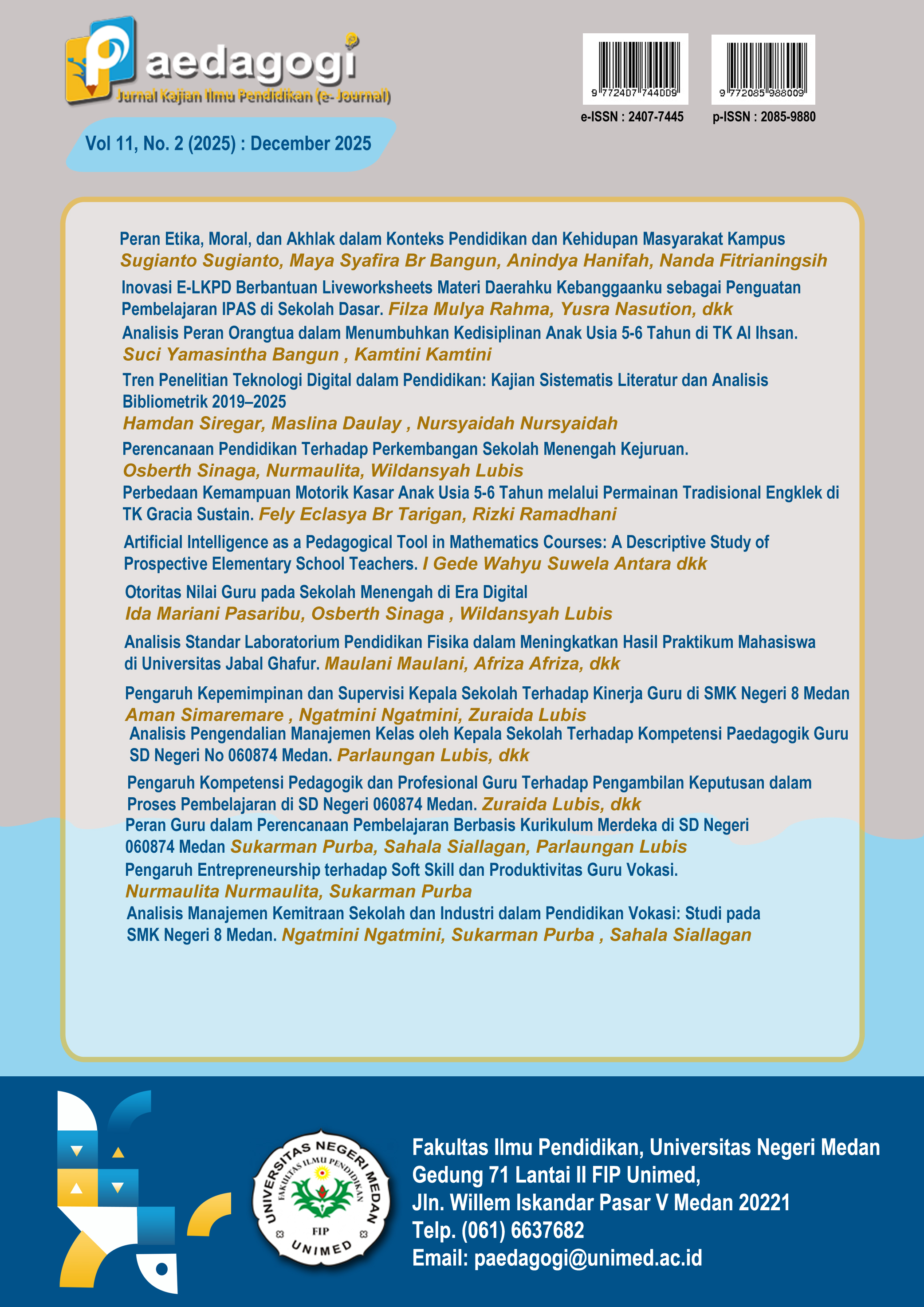
Analisis Manajemen Kemitraan Sekolah dan Industri dalam Pendidikan Vokasi: Studi pada SMK Negeri 8 Medan
DOI:
https://doi.org/10.24114/paedagogi.v11i2.70025Keywords:
Manajemen Pendidikan Vokasi, Kemitraan SMK–DUDI, Evaluasi Berkelanjutan, Strategi AdaptifAbstract
This study analyzes the partnership management between SMK Negeri 8 Medan and the Business and Industrial World based on four management functions: planning, organizing, implementing, and evaluating. The research highlights the importance of synergistic collaboration between vocational education and industry to produce competent and work-ready graduates. A mixed-methods approach was applied through interviews, observations, document analysis, and questionnaires involving 40 respondents from the school, students, and industry partners. Qualitative data were analyzed using the Miles and Huberman model, while quantitative data were processed through descriptive percentage analysis. The results show that the overall effectiveness of partnership management is in the “Good” category (average 65%). Key supporting factors include leadership commitment and teacher–student enthusiasm, while obstacles involve limited industrial partners and weak evaluation systems. Adaptive strategies include expanding partnerships, conducting industry-based teacher training, and implementing continuous evaluation. It is concluded that the effectiveness of SMK–DUDI partnerships largely depends on the school’s managerial ability to apply the four management functions integratively and adaptively to industrial dynamics.
References
Chen, Y., Spady, W. G., & Liu, H. (2024). Outcome-Based Education and Curriculum Reform: Ensuring Graduate Competence in the 21st Century. Journal of Educational Development, 12(3), 115–130. https://doi.org/10.1016/j.jed.2024.03.005
Korneeva, E., Vaganova, O., & Maksimova, K. (2023). Vocational Education Partnership Management in Industrial Collaboration. European Journal of Educational Management, 36(2), 44–59. https://doi.org/10.46303/ejem.2023.5
Mala, D., Hartono, S., & Widodo, A. (2025). Manajemen Pendidikan Vokasi di Era Link and Match: Strategi, Implementasi, dan Evaluasi. Jurnal Manajemen Pendidikan Vokasi Indonesia, 5(1), 12–27. https://doi.org/10.56799/jceki.v4i6.10540
Mulyasa, E. (2021). Manajemen Pendidikan: Konsep, Strategi, dan Aplikasi dalam Meningkatkan Mutu Pendidikan. Bandung: Remaja Rosdakarya.
Robbins, S. P., & Coulter, M. (2020). Management (14th ed.). Newyork: Pearson Education.
Sahertian, P. A. (2020). Supervisi Pendidikan dalam Peningkatan Profesionalisme Guru. Jakarta: Rajawali Pers.
Spady, W. G. (2020). Outcome-Based Education: Critical Issues and Answers. Arlington, VA: American Association of School Administrators.
Sugiyono. (2022). Metode Penelitian Pendidikan (Kuantitatif, Kualitatif, dan R&D). Bandung: Alfabeta.
Yudiono, H., Prasetya, T., & Lestari, S. (2021). Evaluasi Program Kemitraan Sekolah Menengah Kejuruan dan Dunia Industri dalam Meningkatkan Kompetensi Siswa. Jurnal Pendidikan Vokasi Indonesia, 3(2), 101–117. https://doi.org/10.21009/jpvi.032.02
Downloads
Published
Issue
Section
License
Copyright (c) 2026 Ngatmini Ngatmini, Sukarman Purba , Sahala Siallagan

This work is licensed under a Creative Commons Attribution-ShareAlike 4.0 International License.
Authors published with the Paedagogi: Jurnal Kajian Ilmu Pendidikan (e-journal) agree to the following terms:
- Authors retain copyright and grant the journal the right of first publication with the work simultaneously licensed under a Creative Commons Attribution License (CC BY-SA 4.0) that allows others to share the work with an acknowledgment of the work's authorship and initial publication in this journal.
- Authors are able to enter into separate, additional contractual arrangements for the non-exclusive distribution of the journal's published version of the work (e.g., post it to an institutional repository or publish it in a book), with an acknowledgment of its initial publication in this journal.
- Authors are permitted and encouraged to post their work online (e.g., in institutional repositories or on their website) prior to and during the submission process, as it can lead to productive exchanges, as well as earlier and greater citation of published work. (See The Effect of Open Access)