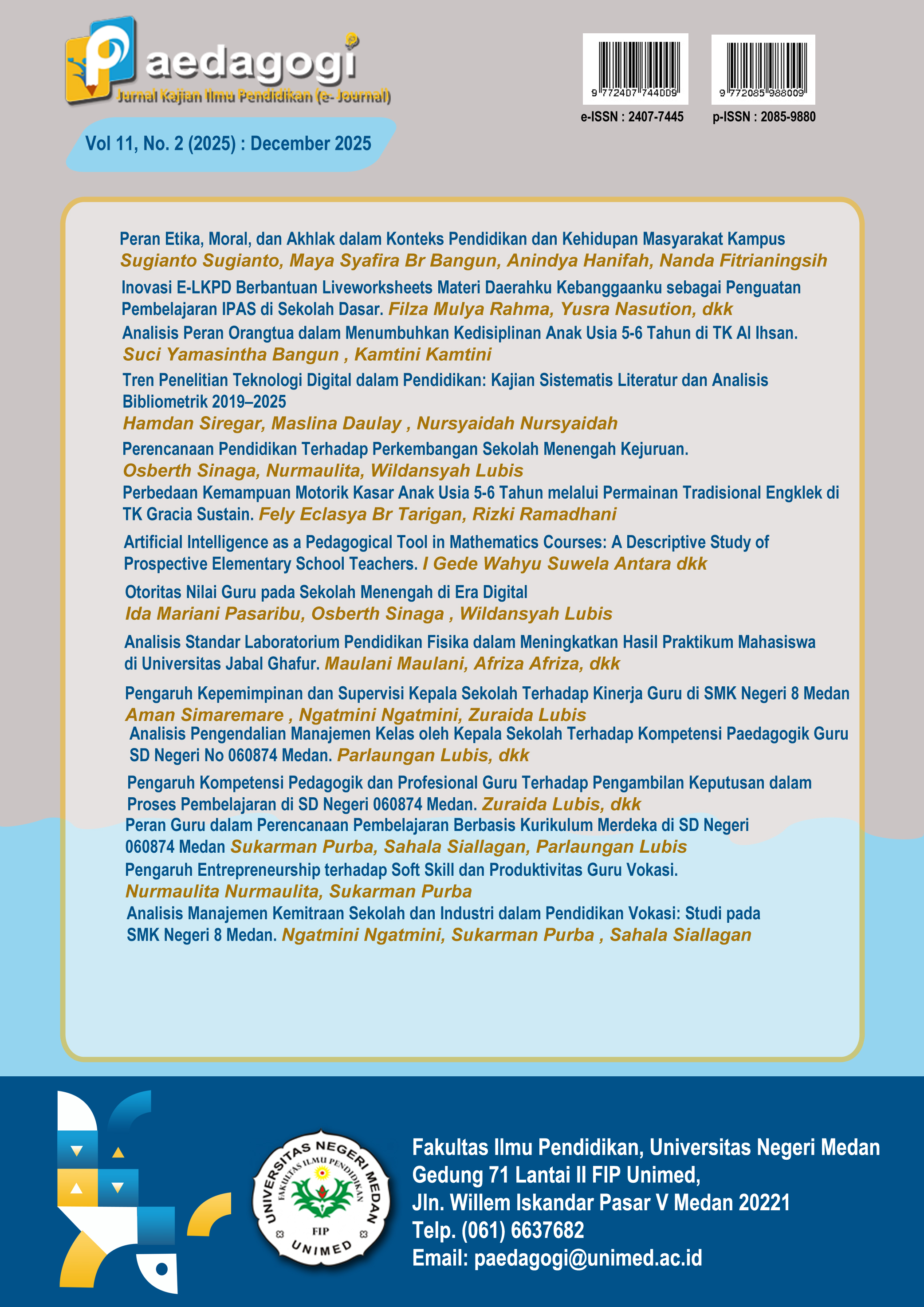
Pengaruh Entrepreneurship terhadap Soft Skill dan Produktivitas Guru Vokasi
DOI:
https://doi.org/10.24114/paedagogi.v11i2.70560Keywords:
Kewirausahaan, Soft Skill, Komitmen Produktivitas Kerja, Guru VokasiAbstract
This study aims to determine the level of vocational teachers’ Soft skills, the overview of their work productivity commitment, and the influence of Soft skills on the work productivity commitment of vocational teachers at SMKN 3 Pematangsiantar. This is a quantitative descriptive study using a survey approach. The population of this study consists of vocational teachers, and data were collected using a Likert-scale questionnaire, which was then analyzed using Microsoft Excel. The results showed that the vocational teachers' Soft skills were in the good category, as reflected in their communication skills, teamwork, time management, and leadership. The teachers’ work productivity was also in the good category, indicated by their consistency in carrying out tasks, commitment to responsibilities, and efforts to improve the quality of teaching. Furthermore, the results of the regression analysis proved that there is a significant influence between Soft skills and the work productivity commitment of vocational teachers. This indicates that the better the teachers’ Soft skills, the higher their commitment to work productivity.
References
Aditya, D. Y., Kencanawaty, G., & Kamali, A. S. (2024). Analisis Produktivitas Kerja Guru SD Negeri di Kabupaten Tasikmalaya pada Mata Pelajaran Matematika. Jurnal Inovasi Pendidikan MH Thamrin, 8(1), 1–13. https://doi.org/10.37012/jipmht.v8i1.1934
Ahda, Yulihasri, & Amelia, D. (2019). Pengaruh Komitmen Kerja, Softskill Dan Spritual Quotient Terhadap Profesionalisme Guru Di SMA Negeri 5 Bukittinggi. Jurnal Visi Manajemen, 5(3), 01-09. https://stiepari.org/index.php/jvm/article/download/302/314
Alviasari, A., Azizah, I., Anggraeni, M. D., & Darpa, M. M. (2025). Analysis of curriculum development and accounting learning at SMK Indonesia Raya. Hipkin Journal of Educational Research, 2(1), 123–138. https://doi.org/10.64014/hipkin-jer.v2i1.41
Arga, B. P., Ihsan, M. Al, Joko, & Basuki, I. (2025). Strategi Manajemen Perubahan Di Smk: Menjembatani Pendidikan Vokasi Dan Kebutuhan Industri 4.0. Pendas: Jurnal Ilmiah Pendidikan Dasar, 10(02), 232-241. https://journal.unpas.ac.id/index.php/pendas/article/view/24798
Badan Pusat Statistik. (2025). Tingkat Pengangguran Terbuka Berdasarkan Tingkat Pendidikan. https://www.bps.go.id/id/statistics-table/2/MTE3OSMy/tingkat-pengangguran-terbuka-berdasarkan-tingkat-pendidikan.html
Maulana, N. (2023). Toward Sustainable Higher Education: Integrating Soft Skill Development Into Business School Curriculum in Indonesia. Journal of Law and Sustainable Development, 11(4), 1–15. https://doi.org/10.55908/sdgs.v11i4.325
Novi, E. K. N., Juru, P., & Obon, W. (2023). Pengaruh Motivasi Kerja Dan Soft Skill Terhadap Profesionalitas Guru kompetensi profesionalitas guru . Motivasi kerja adalah sesuatu yang menimbulkan semangat. Jurnal Ekonomi, Manajemen Pariwisata Dan Perhotelan (Jempper), 2(3), 1-12. https://journalcenter.org/index.php/jempper/article/download/2119/1616/6925
Rasyid Akbar, A., Arifin Siregar, A., & Abdul Wahid, F. (2025). Strategi Efektif dalam Optimalisasi Soft Skills Siswa SMK untuk Kesiapan Kerja dan Daya Saing Global di Era Industri 4.0. PESHUM : Jurnal Pendidikan, Sosial Dan Humaniora, 4(2), 2497–2503. https://doi.org/10.56799/peshum.v4i2.7305
Rina, & Games, D. (2022). Pengaruh Komitmen Kerja , Softskill , dan Lingkungan Kerja terhadap Kinerja Guru di SMK Kesehatan Genus. OPTIMAL, 2(2), 1-20. https://doi.org/10.55606/optimal.v2i2.386
Riskiyana, R., Qomariyah, N., Hidayah, R. N., & Claramita, M. (2022). Towards improving soft skills of medical education in the 21st century : A literature review. International Journal of Evaluation and Research in Education (IJERE), 11(4), 2174–2181. https://doi.org/10.11591/ijere.v11i4.22951
Downloads
Published
Issue
Section
License
Copyright (c) 2026 Nurmaulita Nurmaulita, Sukarman Purba

This work is licensed under a Creative Commons Attribution-ShareAlike 4.0 International License.
Authors published with the Paedagogi: Jurnal Kajian Ilmu Pendidikan (e-journal) agree to the following terms:
- Authors retain copyright and grant the journal the right of first publication with the work simultaneously licensed under a Creative Commons Attribution License (CC BY-SA 4.0) that allows others to share the work with an acknowledgment of the work's authorship and initial publication in this journal.
- Authors are able to enter into separate, additional contractual arrangements for the non-exclusive distribution of the journal's published version of the work (e.g., post it to an institutional repository or publish it in a book), with an acknowledgment of its initial publication in this journal.
- Authors are permitted and encouraged to post their work online (e.g., in institutional repositories or on their website) prior to and during the submission process, as it can lead to productive exchanges, as well as earlier and greater citation of published work. (See The Effect of Open Access)