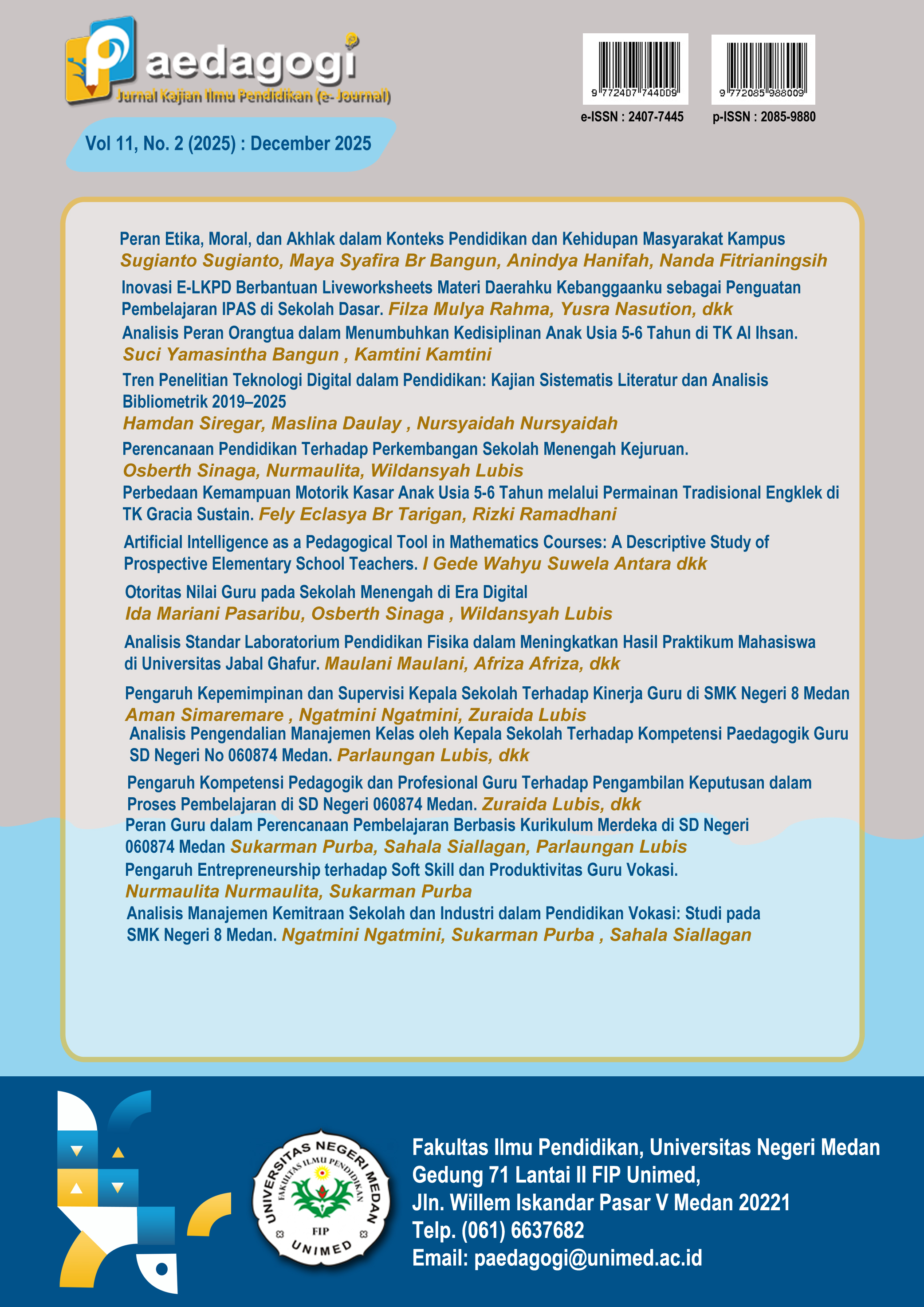
Peran Etika, Moral, dan Akhlak dalam Konteks Pendidikan dan Kehidupan Masyarakat Kampus
DOI:
https://doi.org/10.24114/paedagogi.v11i2.70711Keywords:
Etika , Moral, Akhlak, KarakterAbstract
Rapid social change and massive technological developments have influenced the values entrenched in campus communities, including ethics, morals, and ethics. This article aims to deeply analyze these concepts and their relevance in the context of education and modern society. The research used a literature review method from five accredited national scientific journals. The results of the study indicate that ethics, morals, and ethics have fundamental differences in terms of their sources and applications, yet they complement each other in shaping students' personalities. In the digital era, shifting values demand a new approach to character education to instill these values adaptively. It is clear that strengthening ethics, morals, and ethics through education not only shapes individuals with character but also serves as a foundation for building a civilized campus community. This article discusses ethics, morals, and ethics from an Islamic perspective and how they are applied in everyday life. This article aims to explain the differences and relationships between these three concepts, as well as the importance of ethics in shaping a Muslim's personality. Ethics is a collection of principles, values, or morals that guide a person's behavior. Ethics also relates to good and bad things in behavior, which include a person's moral rights and obligations in living in society.
References
Afandi, A., Nirmala, P., Navia, T. N., Nuraini, V., Dewi, N., Novitri, S. D. A., ... & Sari, D. A. P. (2024). Konsep etika, moral, dan akhlak terpuji dalam Islam dan implementasinya dalam kehidupan sehari-hari. Jurnal Inovasi Pendidikan, 7(5), 152-160. https://ojs.co.id/1/index.php/jip/article/view/1266
Akifah, N., & Adami, F. F. (2025). Akhlak, moral dan etika perspektif Islam. At-Tazakki: Jurnal Kajian Ilmu Pendidikan Islam Dan Humaniora, 9(1), 27-40. http://dx.doi.org/10.47006/attazakki.v9i1.23975
Amarullah, R., & Nasibah, N. (2024). Penguatan etika dan moralitas dalam dakwah pendidikan islam di lingkungan akademis. Ahsan: Jurnal Dakwah dan Komunikasi, 3(1), 56-68. https://ejournal.iain-manado.ac.id/index.php/ahsan/article/view/1002
Arrafi, M. A., Aditya, M. A., Fahlifi, M. S., Ramadhani, Z. R., & Rohman, R. F. (2023). Etika, moral, dan akhlak. Religion: Jurnal Agama, Sosial, Dan Budaya, 2(2), 538-549. https://doi.org/10.55606/religion.v1i2.113
Belgradoputra, R. J. (2023). Pentingnya Etika Moral dan Hukum Dalam Perilaku Masyarakat. Begawan Abioso, 14(1), 13-26. https://doi.org/10.37893/abioso.v14i1.437
Fathurrahman, F., & Nasaruddin, N. (2023). Pendidikan Etika Moral Dalam Perspektif Ibnu Miskawaih. Tajdid: Jurnal Pemikiran Keislaman Dan Kemanusiaan, 7(2), 129-143. https://doi.org/10.52266/tadjid.v7i2.1106
Kasanah, S. U., Rosyadi, Z., Nurngaini, I., & Wafa, K. (2022). Pergeseran Nilai-nilai Etika, Moral dan Akhlak Masyarakat di Era Digital. SINDA: Comprehensive Journal of Islamic Social Studies, 2(1), 68-73. https://doi.org/10.28926/sinda.v2i1.478
Prihatini, S., Mardapi, D., & Sutrisno. (2013). Pengembangan Model Penilaian Akhlak Peserta Didik Madrasah Aliyah. Jurnal Penelitian dan Evaluasi Pendidikan, 2(17), 347-368. https://doi.org/10.21831/pep.v17i2.1705
Sahnan, S. (2024). Urgensi Akhlak, Etika dan Moral dalam Pergaulan. Jurnal Kualitas Pendidikan, 2(2), 201-207. https://ejournal.edutechjaya.com/index.php/jkp/article/view/737
Sugiyono. (2022). Metode Penelitian Kuantitatif, Kualitatif, dan R&D. Bandung: Alfabeta.
Yumesri, R., Sudur, S., & Asrulla, A. (2024). Etika Dalam Peneltian Ilmiah. Jurnal Genta Mulia, 15(2), 63-69. https://ejournal.uncm.ac.id/index.php/gm/article/view/1143
Downloads
Published
Issue
Section
License
Copyright (c) 2025 Sugianto Sugianto, Maya Syafira Br Bangun, Anindya Hanifah, Nanda Fitrianingsih

This work is licensed under a Creative Commons Attribution-ShareAlike 4.0 International License.
Authors published with the Paedagogi: Jurnal Kajian Ilmu Pendidikan (e-journal) agree to the following terms:
- Authors retain copyright and grant the journal the right of first publication with the work simultaneously licensed under a Creative Commons Attribution License (CC BY-SA 4.0) that allows others to share the work with an acknowledgment of the work's authorship and initial publication in this journal.
- Authors are able to enter into separate, additional contractual arrangements for the non-exclusive distribution of the journal's published version of the work (e.g., post it to an institutional repository or publish it in a book), with an acknowledgment of its initial publication in this journal.
- Authors are permitted and encouraged to post their work online (e.g., in institutional repositories or on their website) prior to and during the submission process, as it can lead to productive exchanges, as well as earlier and greater citation of published work. (See The Effect of Open Access)