Pendidikan Agama Islam dan Pembentukan Karakter Sosial Siswa Sekolah Dasar sebagai Fondasi Masyarakat Madani
DOI:
https://doi.org/10.24114/jmpsd.v4i1.77608Abstract
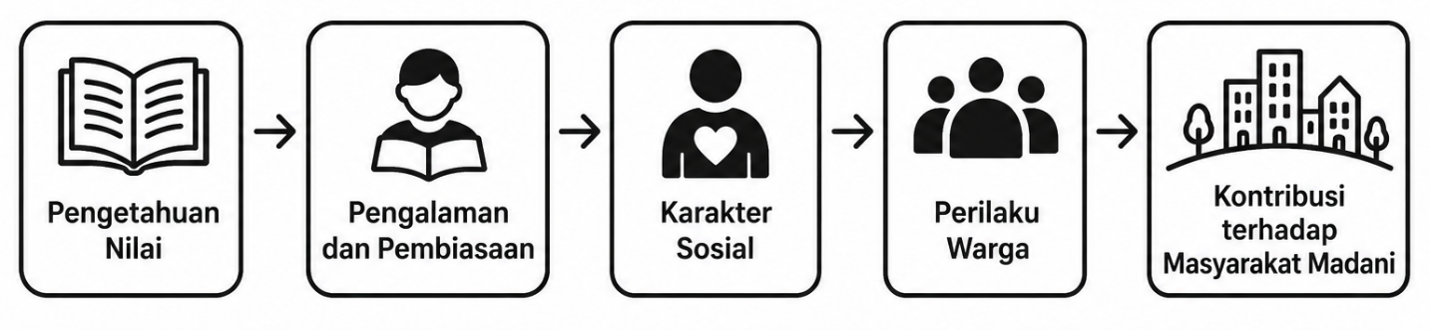
Islamic Religious Education (PAI) at the elementary school level has a strategic role in transforming religious knowledge into social character and culturally respectful behavior. This study aims to analyze the role of PAI in instilling cultural values in elementary school students and its contribution to developing civil society. The study employed a descriptive-qualitative literature review. Twenty-five relevant journal articles, mainly published within the last five years, were selected and analyzed thematically. The synthesis focused on Islamic education, multicultural education, character education, tolerance, local wisdom, social justice, digital ethics, and civil society. The results show that PAI can strengthen tolerance (tasamuh), cooperation (ta’awun), justice (’adl), brotherhood (ukhuwah), respect for differences, and social concern through learning activities, teacher modeling, habituation, collaborative tasks, and school culture. Multicultural approaches do not have to weaken religious identity; instead, they provide contextual opportunities for students to practice religious values in diverse social situations. PAI contributes to civil society gradually, from understanding values to repeated practice and responsible social behavior. In the digital era, this process also requires ethical communication, information verification, and respect for others in digital spaces.
Downloads
References
Abdullah, M. A. (2024). From dialogue to engagement: Experiences of civil society organizations in religious literacy programs for multicultural education curriculum in Indonesia. Jurnal Pendidikan Agama Islam, 21(2), 264–274. https://doi.org/10.14421/jpai.v21i2.10234
Aderibigbe, S. A., Idriz, M., Alzouebi, K., AlOthman, H., Hamdi, W. B., & Companioni, A. A. (2023). Fostering tolerance and respect for diversity through the fundamentals of Islamic education. Religions, 14(2), 212. https://doi.org/10.3390/rel14020212
Adiyono, A., Ni’am, S., & Anshor, A. M. (2024). Islamic character education in the era of Industry 5.0: Navigating challenges and embracing opportunities. Al-Hayat: Journal of Islamic Education, 8(1), 287–304. https://doi.org/10.35723/ajie.v8i1.493
Afriyanto, D., & Anandari, A. (2024). Rekonstruksi konsep pendidikan Islam pada masyarakat madani era modern melalui pendekatan ontologis Al-Qur’an. Jurnal Pengabdian Masyarakat: Pemberdayaan, Inovasi dan Perubahan, 4(6), 325–338. https://doi.org/10.59818/jpm.v4i6.995
Amarullah, R. Q., Ruslandi, R., Fadilah, R. M. Y., Ruswandi, U., & Erihadiana, M. (2024). Effective multicultural education strategies to enhance tolerance in Indonesian schools. Atthulab: Islamic Religion Teaching and Learning Journal, 9(1), 142–151. https://doi.org/10.15575/ath.v9i1.28123
Asbarin, A., Amalia, N. N., & La Jamaa. (2024). Integrasi pendidikan karakter dalam kurikulum Madrasah Ibtidaiyah berbasis kearifan lokal: Studi kasus di Indonesia Timur. IEEJ: Islamic Elementary Education Journal, 3(1), 35–64. https://doi.org/10.47454/IEEJ.2024.v3i1.3
Azzahra, N., & Rosyidah, A. (2024). Mengatasi tantangan intoleransi dengan pendidikan multikultural di era digitalisasi. Muta’allim: Jurnal Pendidikan Agama Islam, 3(4), 227–242. https://doi.org/10.18860/mjpai.v3i4.13185
Djamaluddin, B., Bahri, S., Halim, A., & Chabibi, M. (2024). Deradicalization through multicultural Islamic religious education at the Islamic university. Nazhruna: Jurnal Pendidikan Islam, 7(3), 646–663. https://doi.org/10.31538/nzh.v7i3.34
Haidir, H., Hizbullah, M., Harahap, M. G., Ardat, & Harahap, A. (2023). Eksistensi pendidikan karakter Islami berbasis kearifan lokal dan relevansinya terhadap Program Merdeka Belajar Kampus Merdeka. Fitrah: Journal of Islamic Education, 4(2), 213–231. https://doi.org/10.53802/fitrah.v4i2.410
Idris, M., Willya, E., & Mokodenseho, S. (2024). Strengthening religious tolerance with Islamic views in the era of diversity in Indonesia. WSiSS, 2(2), 106–113. https://doi.org/10.58812/wsiss.v2i02.839
Ihsanniati, N. S., Ramadhan, M. N. G., Thobroni, A. Y., Yaqin, A. A., & Qisom, S. (2024). Keadilan sosial: Konsep keadilan dan peran manusia dalam mewujudkan keadilan perspektif Al-Qur’an. Al-Tadabbur: Jurnal Ilmu Al-Qur’an dan Tafsir, 9(1), 181–192. https://doi.org/10.30868/at.v9i01.6661
Jamiah, K., Hermanto, E., Febriansyah, R., & Perdana, W. (2025). Keadilan sosial dalam perspektif Alquran dan Pancasila. Panangkaran: Jurnal Penelitian Agama dan Masyarakat, 9(1), 68–89. https://doi.org/10.14421/panangkaran.v9i1.4278
Jayadi, K., Abduh, A., & Basri, M. (2022). A meta-analysis of multicultural education paradigm in Indonesia. Heliyon, 8(1), e08828. https://doi.org/10.1016/j.heliyon.2022.e08828
Julismawati, J., & Eliana, N. (2024). Peran guru dalam membentuk karakter peserta didik. Jurnal Review Pendidikan Dasar: Jurnal Kajian Pendidikan dan Hasil Penelitian, 10(3), 255–259. https://doi.org/10.26740/jrpd.v10n3.p255-259
Kharisma, A., Zuhby, N., Purwanti, J., Widyaningrum, D., An-nisa, A., & Rahman, A. (2021). Arus multikultural di Indonesia dalam perspektif Pancasila, Islam, dan kebangsaan. Scaffolding: Jurnal Pendidikan Islam dan Multikulturalisme, 3(2), 109–122. https://doi.org/10.37680/scaffolding.v3i2.1113
Kholida, S., Niam, S., Qomar, M., & Adiyono, A. (2025). Multicultural education from an Islamic perspective: Building intercultural tolerance in Indonesian primary schools. Al-Adzka: Jurnal Ilmiah Pendidikan Guru Madrasah Ibtidaiyah, 15(2), 212–229. https://doi.org/10.18592/aladzkapgmi.v15i2.18244
Lenta, V., & Mustika, D. (2023). Budaya sekolah dalam mewujudkan pendidikan karakter di SDN 115 Pekanbaru. Mimbar Pendidikan Indonesia, 4(2), 348–356. https://doi.org/10.23887/mpi.v4i2.65938
Mascluhah, L., Marfu’ah, M., & Rahmawati, I. (2024). Pengaruh etika Islam terhadap sikap toleransi dan keterbukaan pada pendidikan dasar multikultural berbasis moderasi beragama. FAJAR Jurnal Pendidikan Islam, 4(2), 112–130. https://doi.org/10.56013/fj.v4i2.3455
Mawadda, M., Supriadi, U., Anwar, S., & Abbas, H. M. (2023). Tolerance learning in Islamic religious and character education textbooks. Analisa: Journal of Social Science and Religion, 8(1), 51–66. https://doi.org/10.18784/analisa.v8i1.1901
Nisa, S. A. Z. (2021). Konsep toleransi dalam keberagaman: Analisis atas penafsiran Q.S. Al-Hujurat ayat 13 dalam Al-Qur’an dan Tafsir Kemenag versi website. Contemporary Quran, 1(1), 40–50. https://doi.org/10.14421/cq.2021.0101-05
Putri, A., Nurhuda, A., Assajad, A., & Sinta, D. (2024). The importance of building religious tolerance in Indonesia through multicultural education from an Islamic perspective. Falasifa: Jurnal Studi Keislaman, 15(1), 1–9. https://doi.org/10.62097/falasifa.v15i1.1480
Ramadani, S. (2024). Pembelajaran pendidikan agama Islam berbasis multikultural dalam mewujudkan toleransi di Sekolah Dasar Swasta Melati Kota Medan. Adabiyah Islamic Journal, 2(2), 102–116. https://doi.org/10.31289/aij.v2i2.8543
Shobirin, M. Y., & Wahid, M. I. (2023). The roles of multicultural Islamic education in the empowerment of civil society. Jurnal Penelitian Keislaman, 19(2), 176–185. https://doi.org/10.20414/jpk.v19i2.8415
Sholihah, A., & Syafi’i, I. (2022). Civil society dan multikulturalisme dalam pendidikan Islam. Indonesian Journal of Sociology, Education and Development, 4(2). https://doi.org/10.52483/ijsed.v4i2.79
Ulfa, U., Mufidah, C. H., Susilawati, S., & Barizi, A. (2022). Multicultural Islamic education in Indonesia: The urgency value of model and method. ADDIN, 16(1), 131–164. https://doi.org/10.21043/addin.v16i1.15787
Downloads
Published
Issue
Section
License
Copyright (c) 2026 Aida Fitriani, Elis Dahliyanti, Juwita Fadilla, Nazwa Aisyah Putri, Putri Ravika Hasanah, Rasyiqah Aqila Putri, Tania Ratna Palupi

This work is licensed under a Creative Commons Attribution 4.0 International License.
Authors who publish with this journal agree to the following terms:
Authors retain copyright and grant the journal right of first publication with the work simultaneously licensed under a Creative Commons Attribution 4.0 International that allows others to share the work with an acknowledgement of the work's authorship and initial publication in this journal.
Authors are able to enter into separate, additional contractual arrangements for the non-exclusive distribution of the journal's published version of the work (e.g., post it to an institutional repository or publish it in a book), with an acknowledgement of its initial publication in this journal.
Authors are permitted and encouraged to post their work online (e.g., in institutional repositories or on their website) prior to and during the submission process, as it can lead to productive exchanges, as well as earlier and greater citation of published work.