Integrasi Nilai-Nilai Islam dalam Pembelajaran IPS untuk Membentuk Self-Control Siswa Madrasah Ibtidaiyah
DOI:
https://doi.org/10.24114/jmpsd.v4i1.77623Abstract
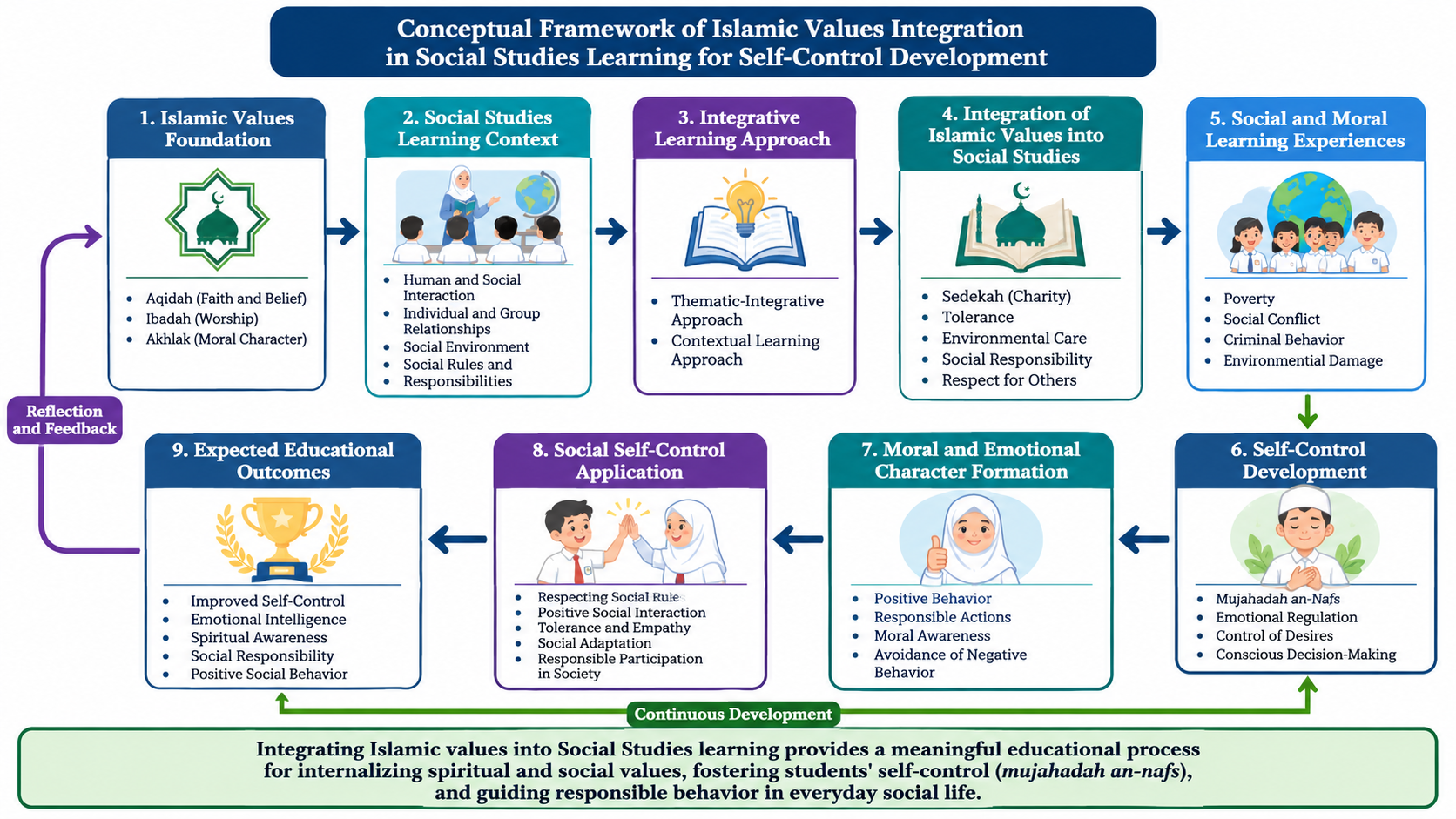
The study aims to describe the concept of religious values and social studies learning in students' self-control education using an integrative approach. This is the background for researchers to raise issues regarding the integration of religious values in social studies subjects in self-control education for fifth-grade students at MI. This type of research is qualitative. Data collection techniques through interviews. Interviews were conducted with fifth-grade teachers. While data analysis techniques used data reduction, data presentation, and conclusion. Interviews were conducted directly using structured interviews to explore existing information. The results of this study are the integration of religious values in social studies subjects that have been carried out at MI Al Huda, self-control education originating from religious values is very necessary because with that students can exercise self-control, as well as in social studies education students are taught how to adapt as a social being full of self-control. Therefore religion and social studies have the same goal, namely to educate students to have emotional intelligence or in other words self-control.
Downloads
References
Arafa, S., Mursalim, & Ihsan. (2022). Pengaruh kecerdasan emosional terhadap prestasi belajar siswa SD Negeri 26 Kota Sorong. Jurnal Papeda: Jurnal Publikasi Pendidikan Dasar, 4(1), 47–54. https://doi.org/10.36232/jurnalpendidikandasar.v4i1.2061
Arofaturrohman, Y. A., Alqudsi, Z., & Fauziati, E. (2023). Implementasi teori belajar humanisme dalam pembelajaran Pendidikan Agama Islam perspektif Carl Rogers. Tsaqofah, 3(1), 140–147. https://doi.org/10.58578/tsaqofah.v3i1.837
As, U. S., Dz, A. S., & Mustoip, S. (2023). Eksplorasi implementasi pendidikan karakter di sekolah dasar: Studi kualitatif. Edubase: Journal of Basic Education, 4(1). https://doi.org/10.47453/edubase.v4i1.803
Bahri, S., Syahril, S., & Yanti, D. (2023). Peranan guru Pendidikan Agama Islam dalam membina akhlak peserta didik kelas 5 dan 6 di SD IT Asy-Syamil Tungkal Jaya Kabupaten Musi Banyuasin tahun pembelajaran 2022–2023. Unisan Jurnal, 2(3), 269–279. https://journal.an-nur.ac.id/index.php/unisanjournal/article/view/997
Chairunnisa, D., Afriatin, T. S., & Firmansyah, M. I. (2020). Implementasi Permendikbud No. 22 Tahun 2016 tentang standar proses dalam pembelajaran PAI di SMP Inovatif Al-Ibda’. Ta'lim: Jurnal Pendidikan Agama Islam, 18(1), 53–64. https://ejournal.upi.edu/index.php/taklim/article/view/32819
Fatkhurohman, M., & Syam, R. S. E. (2023). Relasi sains dan agama: Materi besaran dan satuan dalam meningkatkan keimanan peserta didik. Jurnal Riset Rumpun Matematika dan Ilmu Pengetahuan Alam, 2(1), 213–224. https://doi.org/10.55606/jurrimipa.v2i1.782
Hamonangan, R. H., & Widiyarto, S. (2019). Pengaruh self-regulated learning dan self-control terhadap hasil belajar bahasa Indonesia. Jurnal Dimensi Pendidikan dan Pembelajaran, 7(1), 5–10. https://doi.org/10.24269/dpp.v7i1.1056
Hidayat Nasution, I. M., Rangkuti, P., & Sari, H. P. (2025). Aksiologi pendidikan agama Islam dalam membentuk generasi digital berkarakter Islam. Jurnal Merah Putih Sekolah Dasar, 2(5), 452–462. https://doi.org/10.24114/jmpsd.v2i5.70331
Inzlicht, M., Schmeichel, B. J., & Macrae, C. N. (2014). Why self-control seems (but may not be) limited. Trends in Cognitive Sciences, 18(3), 127–133. https://doi.org/10.1016/j.tics.2013.12.009
Ismail, I., & Rosidi, M. I. (2023). Pemanfaatan kebudayaan Powele dalam pembelajaran IPS. Journal on Education, 5(4), 16630–16636. https://doi.org/10.31004/joe.v5i4.2808
Kartini, T. (2010). Pendekatan tematik dalam pembelajaran IPS. EduHumaniora: Jurnal Pendidikan Dasar Kampus Cibiru, 2(2). https://doi.org/10.17509/eh.v2i2.2767
Khobir, A. (2009). Pendidikan agama Islam di era globalisasi. Forum Tarbiyah, 7(1). https://e-journal.uingusdur.ac.id/index.php/forumtarbiyah/article/view/248
Mahmudi, A., Mukniah, M., & Rofiq, N. (2020). Integration of religious value education in theoretical social reconstruction curriculum model. Ghaitsa: Islamic Education Journal, 1(3). https://doi.org/10.62159/ghaitsa.v1i3.92
Ningrum, I. K., & Astuti, K. (2023). Kontrol diri dan konformitas teman sebaya dengan perilaku bullying pada siswi. Jurnal Psikologi, 19(1), 23–31. https://ejournal.up45.ac.id/index.php/psikologi/article/view/1482
Nur’aeni, E. (2022). Peran guru aqidah dalam meningkatkan self-control remaja (Studi kasus di MTs Al-Khairiyah Kalodran Serang). Jurnal Inovasi Penelitian, 3(1). https://doi.org/10.47492/jip.v3i1.1653
Subakri, S. (2022). Peran guru dalam pandangan Al-Ghazali. Jurnal Pendidikan Guru. https://doi.org/10.47783/jurpendigu.v1i2.165
Mirnawati, M., Oktavianty, N., Judrah, M., Safaruddin, S., & Akbar. (2023). Peran guru Pendidikan Agama Islam dalam meningkatkan kecerdasan emosional peserta didik. Journal of Instructional and Development Researches, 3(1), 35–40. https://doi.org/10.53621/jider.v3i1.106
Putri, A. H., Nurmayani, N., Anandhita, V., Chaniago, S. A., Natasya, F., & Nurmaini, A. (2025). Pengaruh pembelajaran Pendidikan Agama Islam terhadap sumber-sumber ajaran Islam pada siswa kelas V SD. Jurnal Merah Putih Sekolah Dasar, 2(3), 208–215. https://doi.org/10.24114/jmpsd.v2i3.69488
Sastradiharja, E. J., Sarnoto, A. Z., & Nurikasari, N. (2023). Pengembangan kecerdasan emosi untuk meningkatkan sikap sosial siswa sekolah dasar. Ulumuddin: Jurnal Ilmu-Ilmu Keislam
Downloads
Published
Issue
Section
License
Copyright (c) 2026 Rubi Alamsyah Mamonto, Endah Marwanti, Sabarudin Sabarudin, Laras Meila, Laras Meila

This work is licensed under a Creative Commons Attribution 4.0 International License.
Authors who publish with this journal agree to the following terms:
Authors retain copyright and grant the journal right of first publication with the work simultaneously licensed under a Creative Commons Attribution 4.0 International that allows others to share the work with an acknowledgement of the work's authorship and initial publication in this journal.
Authors are able to enter into separate, additional contractual arrangements for the non-exclusive distribution of the journal's published version of the work (e.g., post it to an institutional repository or publish it in a book), with an acknowledgement of its initial publication in this journal.
Authors are permitted and encouraged to post their work online (e.g., in institutional repositories or on their website) prior to and during the submission process, as it can lead to productive exchanges, as well as earlier and greater citation of published work.