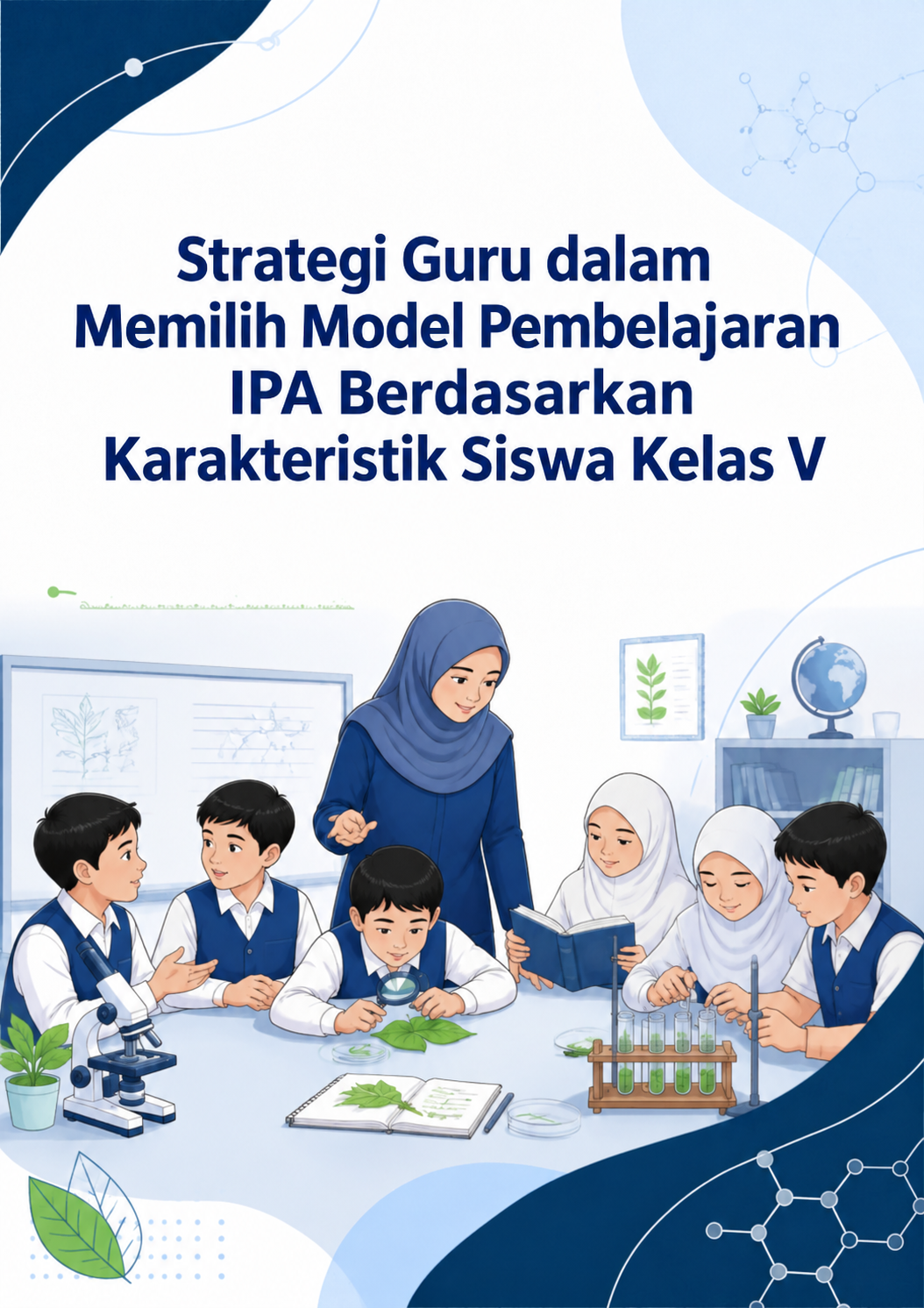
Strategi Guru dalam Memilih Model Pembelajaran IPA Berdasarkan Karakteristik Siswa Kelas V
DOI:
https://doi.org/10.24114/jmpsd.v4i1.77856Abstract
This study describes a teacher’s strategies for selecting learning models that suit the characteristics of fifth-grade students in class V-A at MIS Al-Quba. It employed a descriptive qualitative approach. Data were collected through direct observation of science lessons and a question-and-answer session with the classroom teacher about model-selection considerations. The research took place on November 3, 2026, with approximately two hours of observation in a class of 34 students. Data were analyzed descriptively by selecting relevant information, presenting the data, and drawing conclusions. The findings show that the suitability of the subject matter is the teacher’s primary consideration when selecting a learning model. The teacher first considers the nature of the material and the learning objectives, then takes students’ diverse circumstances into account. To understand students’ characteristics, the teacher seeks to recognize each student’s condition, particularly differences in ability and needs for learning support. The teacher explained that Project-Based Learning (PjBL) may be selected when the material allows project-based activities. After selecting a model, the teacher continues to guide students according to their needs and abilities. The findings indicate that model selection involves considering the subject matter, learning objectives, and students’ classroom conditions.
Downloads
References
Angelia, Y., Supeno, & Suparti. (2022). Keterampilan Proses Sains Siswa Sekolah Dasar dalam Pembelajaran IPA Menggunakan Model Pembelajaran Inkuiri. JURNAL BASICEDU, 6(5), 8296–8303.
Hadi, A., Asrori, & Rusman. (2021). Penelitian Kualitatif Studi Fenomenologi, Case Study, Grounded Theory, Etngrafi, Biografi (I). CV. Pena Persada.
Hasanah, O. N., & Sukartono. (2024). PENERAPAN PEMBELAJARAN BERDIFERENSIASI DALAM KURIKULUM MERDEKA PADA MATA PELAJARAN IPAS DI SEKOLAH DASAR. ELSE (Elementary School Education Journal), 8(1), 204–213.
Kusumaningputri, A. R. (2024). Implementasi Pembelajaran Berdiferensiasi pada Pembelajaran IPAS Fase B Kelas IV Sekolah Dasar. Jurnal Didaktika Pendidikan Dasar, 8(1), 199–220.
Miles, M. B., Huberman, A. M., & Saldaña, J. (2014). Qualitative Data Analysis: A Methods Sourcebook (3rd ed.). SAGE Publication, Inc.
Mutanaffisah, R., Ningrum, R., & Widodo, A. (2021). Ketepatan pemilihan pendekatan, metode, dan media terhadap karakteristik materi IPA The accuracy of the selection of approaches, methods, and media for the characteristics of combined science materials. Jurnal Inovasi Pendidikan IPA, 7(1), 12–21.
Nency, T. (2023). METODE PROJECT-BASED LEARNING UNTUK MENINGKATKAN HASIL BELAJAR IPA MATERI SIKLUS AIR BAGI SISWA KELAS V SEKOLAH DASAR. Jurnal Didaktika Pendidikan Dasar, 7(3), 1107–1122.
Pangestu, K., Malagola, Y., Robbaniyah, I., & Rahajeng, D. (2024). The Influence of Project Based Learning on Learning Outcomes , Creativity and Student Motivation in Science Learning at Elementary Schools. Jurnal Prima Edukasia, 12(2), 194–203.
Purnasari, P. D., Sumarni, M. L., & Sadewo, Y. D. (2022). Pendampingan Pemilihan Model Pembelajaran Ditinjau Dari Perkembangan Kognitif Siswa Sekolah Dasar. Jurnal Publikasi Pendidikan, 12(11), 75–82.
Putri, N. L. V. W., & Mangunsong, F. M. (2024). Empowering Educators : Exploring Teacher Understanding and Implementation of Differentiated Instruction in Indonesian Primary Schools. Mimbar Sekolah Dasar, 11(3), 542–556.
Sahrul, M., Mustamiroh, Dwiyono, Y., & Haerani, R. P. R. (2023). Penerapan Model Pembelajaran Discovery Learning untuk Meningkatkan Hasil Belajar IPA Materi Pesawat Sederhana pada Siswa Sekolah Dasar. JPM: Jurnal Pendidikan MIPA, 13(4), 1022–1029.
Santoso, T. (2022). Prof. Dr. Thomas Santoso, M.Si. CV. Saga Jawadwipa Pustaka Saga.
Septiaseh, D., Pratama, G. C., Haniah, M., & Ridhaningtyas, L. P. (2024). ANALISIS GAYA BELAJAR SISWA SEKOLAH DASAR DI TINJAU DARI PEMBELAJARAN BERDIFERENSIASI DALAM KURIKULUM MERDEKA : LITERATUR REVIEW. JP-SA: Jurnal Pendidikan Sultan Agung, 4(3), 235–247.
Surya, Y. F., Sumianto, Witarsa, R., & Subhanadri. (2023). PENERAPAN PROJECT-BASED LEARNING (PJBL) UNTUK MENINGKATKAN KETERAMPILAN PROSES SAINS DAN HASIL BELAJAR IPA. Pendas : Jurnal Ilmiah Pendidikan Dasar, 08(01), 223–233.
Sutimah, & Tyas, D. N. (2024). Implementasi Model Pembelajaran Inquiry Based Learning pada Mata Pelajaran IPAS dalam Konteks Kurikulum Merdeka di Sekolah Dasar. Jurnal Basicedu, 8(4), 2941–2952.
Triyanti, A., Heryati, L., Dewi, G. S., Mascita, D. E., & Rahayu, I. (2024). Exploring the Application of Differentiated Learning in Elementary Schools. Internatinal Journal of Educational Research Excellence (IJERE), 03(01), 405–412.
Winanda, A. D., Suryanti, & Budijastuti, W. (2022). Pengembangan Buku Ajar IPA Berbasis Model Pembelajaran Inkuiri untuk Melatihkan Keterampilan Saintifik Siswa Sekolah Dasar. Jurnal Basicedu, 6(5), 8971–8980.
Yani, F., Witarsa, R., & Masrul. (2024). Pengaruh Model Pembelajaran Inkuiri terhadap Hasil Belajar IPAS di Sekolah Dasar. Journal of Education Research, 5(1), 705–710.
Yuniasih, E., Herlina, A., Hadiyanti, D., & Zaini, E. (2022). Penerapan Model Project Based Learning untuk Meningkatkan Keterampilan Proses dan Hasil Belajar IPA Siswa Sekolah Dasar. Edukatif : Jurnal Ilmu Pendidikan, 4(5), 6670–6677.
Zuliyawati, E. M., & Agustin, A. S. (2024). ANALISIS RESPON PESERTA DIDIK TERHADAP PENGUATAN LITERASI DALAM PEMBELAJARAN IPAS BERDIFERENSIASI DI SEKOLAH DASAR. Jurnal Didakttika Pendidikan Dasar, 8(2),
Downloads
Published
Issue
Section
License
Copyright (c) 2026 Dira Supratiwi, Annisa Hapsari, Afrida Hanum Lubis, Fazira Nazwa, Julia Amelia Sormin, Rendi Prilandi, Syazilla Machreni, Suyit Ratno

This work is licensed under a Creative Commons Attribution 4.0 International License.
Authors who publish with this journal agree to the following terms:
Authors retain copyright and grant the journal right of first publication with the work simultaneously licensed under a Creative Commons Attribution 4.0 International that allows others to share the work with an acknowledgement of the work's authorship and initial publication in this journal.
Authors are able to enter into separate, additional contractual arrangements for the non-exclusive distribution of the journal's published version of the work (e.g., post it to an institutional repository or publish it in a book), with an acknowledgement of its initial publication in this journal.
Authors are permitted and encouraged to post their work online (e.g., in institutional repositories or on their website) prior to and during the submission process, as it can lead to productive exchanges, as well as earlier and greater citation of published work.