Peningkatan Kemampuan Menentukan Ide Pokok Paragraf pada Teks Eksplanasi melalui Strategi PQ4R di Kelas V Sekolah Dasar
DOI:
https://doi.org/10.24114/jmpsd.v4i1.77891Abstract
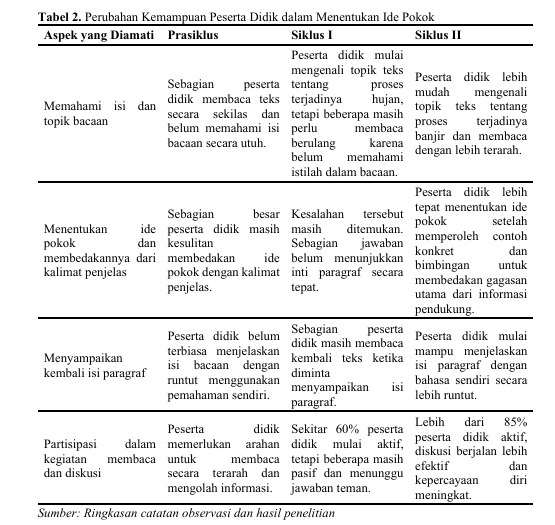
Identifying paragraph main ideas is a key part of reading comprehension, particularly when learners read explanatory texts. This classroom action research examined the use of the Preview, Question, Read, Reflect, Recite, Review (PQ4R) strategy to improve fifth-grade learners’ ability to identify main ideas at SD Negeri 4 Banyuasin III. The study involved 19 learners and was conducted in two cycles, each consisting of planning, action, observation, and reflection. Data were collected through classroom observation, written tests, and documentation, then analyzed descriptively using the proportion of learners who scored at least 70. Mastery increased from 42.1% (8 learners) in the pre-cycle to 63.2% (12 learners) in Cycle I and 89.5% (17 learners) in Cycle II. Classroom observations also showed greater participation and improvement in learners’ questions and oral explanations. Cycle II adjustments included using a familiar text, clarifying the difference between main ideas and supporting details, and providing closer guidance during discussion. The results indicate improvement in this class and attainment of the 85% mastery target.
Downloads
References
Apreasta, L. (2023). Pengembangan buku ajar membaca pemahaman menggunakan strategi PQ4R di kelas V sekolah dasar. Jurnal Pendidikan Tambusai, 7(1), 1840–1846. https://doi.org/10.31004/jptam.v7i1.5496
Arifah, D. N., Utami, N. C. M., & Dulyapit, A. (2026). Systematic literature review: The effectiveness of PQ4R-based E-LKPD on elementary school students’ reading comprehension skills. Journal of General Education and Humanities, 5(1), 1617–1628. https://doi.org/10.58421/gehu.v5i1.1162
Conradi Smith, K., Williams, T. W., & Frackelton, E. P. (2024). “No more strategy of the week”: Considerations for connecting comprehension instruction back to the book. The Reading Teacher, 77(4), 512–521. https://doi.org/10.1002/trtr.2261
Dahl-Leonard, K., Hall, C., & Peacott, D. (2024). A meta-analysis of technology-delivered literacy instruction for elementary students. Educational Technology Research and Development, 72, 1507–1538. https://doi.org/10.1007/s11423-024-10354-0
Denton, C. A., Hall, C., Cho, E., Cannon, G., Scammacca, N., & Wanzek, J. (2022). A meta-analysis of the effects of foundational skills and multicomponent reading interventions on reading comprehension for primary-grade students. Learning and Individual Differences, 93, 102062. https://doi.org/10.1016/j.lindif.2021.102062
Dihan, W., Hidayat, M., & Nugraha, U. (2022). Penerapan metode PQ4R untuk meningkatkan keterampilan membaca pemahaman pada pembelajaran Bahasa Indonesia siswa kelas VI SD. Jurnal Pendidikan Tematik Dikdas, 7(1), 88–100. https://doi.org/10.22437/jptd.v7i1.19544
Duke, N. K., Ward, A. E., & Pearson, P. D. (2021). The science of reading comprehension instruction. The Reading Teacher, 74(6), 663–672. https://doi.org/10.1002/trtr.1993
Filderman, M. J., Austin, C. R., Boucher, A. N., O’Donnell, K., & Swanson, E. A. (2022). A meta-analysis of the effects of reading comprehension interventions on the reading comprehension outcomes of struggling readers in third through 12th grades. Exceptional Children, 88(2), 163–184. https://doi.org/10.1177/00144029211050860
Hakim, H. R., Faresty, I., Sirait, J., Azkia, N., Mariam Fauziyah, Z., & Fitriani, A. D. (2026). Efektivitas metode PQ4R (Preview, Question, Read, Reflect, Recite, Review) untuk meningkatkan keterampilan membaca pemahaman siswa kelas IV sekolah dasar. Jurnal Basicedu, 10(2), 511–519. https://doi.org/10.31004/basicedu.v10i2.11098
Hall, C., Dahl-Leonard, K., Cho, E., Solari, E. J., Capin, P., Conner, C. L., Henry, A. R., Cook, L., Hayes, L., Vargas, I., Richmond, C. L., & Kehoe, K. F. (2023). Forty years of reading intervention research for elementary students with or at risk for dyslexia: A systematic review and meta-analysis. Reading Research Quarterly, 58(2), 285–312. https://doi.org/10.1002/rrq.477
Hannon, B. (2022). Children’s comprehension of narrative and expository texts: The contributions of word decoding and knowledge integration skills vary within and between text types. Journal of Education and Training Studies, 10(4), 10–20. https://doi.org/10.11114/jets.v10i4.5465
Härtig, H., Bernholt, S., Fraser, N., Cromley, J. G., & Retelsdorf, J. (2022). Comparing reading comprehension of narrative and expository texts based on the direct and inferential mediation model. International Journal of Science and Mathematics Education, 20(Suppl. 1), 17–41. https://doi.org/10.1007/s10763-022-10302-5
Hudson, A. K., Owens, J., Moore, K. A., Lambright, K., & Wijekumar, K. (2021). “What’s the main idea?”: Using text structure to build comprehension. The Reading Teacher, 75(1), 113–118. https://doi.org/10.1002/trtr.2016
Hwang, H., Cabell, S. Q., & Joyner, R. E. (2022). Effects of integrated literacy and content-area instruction on vocabulary and comprehension in the elementary years: A meta-analysis. Scientific Studies of Reading, 26(3), 223–249. https://doi.org/10.1080/10888438.2021.1954005
Istiqomah, F., & Juansah, D. E. (2024). Metode PQ4R dalam kemampuan pemahaman membaca siswa sekolah dasar: Systematic literature review (SLR). Ideguru: Jurnal Karya Ilmiah Guru, 10(1), 178–186. https://doi.org/10.51169/ideguru.v10i1.1166
Kartika, E., Heryani, R., & Anasta, N. D. C. (2025). Perbandingan strategi DRTA dengan PQ4R terhadap membaca pemahaman peserta didik Fase C sekolah dasar. JRPD (Jurnal Riset Pendidikan Dasar), 8(2), 269–278. https://doi.org/10.26618/h9dxhv52
Kasno. (2022). Mengidentifikasi gagasan pokok paragraf melalui strategi pembelajaran partisipatif di kelas IV SDN 1 Pangkalan Satu. Anterior Jurnal, 22(Special-1), 91–96. https://doi.org/10.33084/anterior.v22iSpecial-1.3226
Kusumajati, A. P., Muhroji, M., & Ratnawati, W. (2022). Upaya meningkatkan keterampilan membaca pemahaman melalui strategi PQ4R di kelas 3B SD Negeri Telukan 02. Educatif: Journal of Education Research, 4(3), 291–297. https://doi.org/10.36654/educatif.v4i3.241
Monalisa, I., Apriliana, A. C., & Sumantri, M. S. (2025). Pengaruh strategi PQ4R (Preview, Question, Read, Reflect, Recite, Review) berbantuan Literacy Cloud terhadap keterampilan membaca pemahaman pada pembelajaran Bahasa Indonesia siswa kelas V SD. Pendas: Jurnal Ilmiah Pendidikan Dasar, 10(3), 468–476. https://doi.org/10.23969/jp.v10i03.29550
Parlindungan, F., & Prasetya, W. (2022). Literature review on trends of comprehension instruction for elementary school students. Education and Human Development Journal, 7(1), 42–54. https://doi.org/10.33086/ehdj.v7i01.2589
Pratiwi, T., Hermuttaqien, B. P. F., & Faisal, M. (2023). Pengaruh penerapan strategi pembelajaran PQ4R terhadap kemampuan membaca pemahaman siswa kelas V. Pinisi Journal Pendidikan Guru Sekolah Dasar, 3(1). https://doi.org/10.70713/pjp.v3i1.34891
Rahayu, E. W., & Mustadi, A. (2022). The read-aloud method to develop reading literacy at school’s educational park. Jurnal Prima Edukasia, 10(2), 104–113. https://doi.org/10.21831/jpe.v10i2.47331
Rollins, L. H., Sanders, S., Jolivette, K., & Virgin, A. S. (2022). Assessment of strategy instruction and self-regulation in reading comprehension: A review of the literature. Preventing School Failure: Alternative Education for Children and Youth, 66(4), 301–311. https://doi.org/10.1080/1045988X.2022.2132198
Sun, Y., Wang, J., Dong, Y., Zheng, H., Yang, J., Zhao, Y., & Dong, W. (2021). The relationship between reading strategy and reading comprehension: A meta-analysis. Frontiers in Psychology, 12, 635289. https://doi.org/10.3389/fpsyg.2021.635289
Triana, P. M., Pradana, A. B. A., & Wardana, A. E. (2024). Reading comprehension in elementary levels: A systematic literature review. Jurnal Bidang Pendidikan Dasar, 8(2), 114–121. https://doi.org/10.21067/jbpd.v8i2.10278
Downloads
Published
Issue
Section
License
Copyright (c) 2026 Sovita Sari, Nurdin Kamil, Mazda Leva Okta Safitri, Suratmi

This work is licensed under a Creative Commons Attribution 4.0 International License.
Authors who publish with this journal agree to the following terms:
Authors retain copyright and grant the journal right of first publication with the work simultaneously licensed under a Creative Commons Attribution 4.0 International that allows others to share the work with an acknowledgement of the work's authorship and initial publication in this journal.
Authors are able to enter into separate, additional contractual arrangements for the non-exclusive distribution of the journal's published version of the work (e.g., post it to an institutional repository or publish it in a book), with an acknowledgement of its initial publication in this journal.
Authors are permitted and encouraged to post their work online (e.g., in institutional repositories or on their website) prior to and during the submission process, as it can lead to productive exchanges, as well as earlier and greater citation of published work.