





PENGARUH MODUL TERMOKIMIA BERBASIS STEM TERHADAP HASIL BELAJAR DAN MOTIVASI BELAJAR MAHASISWA PADA MATA KULIAH KAPITA SELEKTA KIMIA
- Authors
-
-
Susilawati Amdayani
Universitas Negeri Medan
-
Makharany Dalimunthe
Universitas Negeri Medan
-
Haqqi Annazili Nasution
Universitas Negeri Medan
-
- Keywords:
- Effectiveness, Module, STEM, Learning Outcomes, Thermochemistry.
- Abstract
-
This research is motivated by the low ability of students in developing critical thinking skills and problem solving and the lack of student motivation to develop science and link chemistry with other science. This research is a quantitative research. This study aims to determine the effectiveness of STEM-based modules on learning outcomes and student motivation. The type of research used is a quasi-experimental design using a non-equivalent control group pretest-posttest design. The data collection method used was a multiple choice test to measure learning outcomes and a questionnaire to analyze learning motivation. The results showed that the use of STEM-based modules had an effect on student learning outcomes and learning motivation in selected subjects.
- Downloads
-
Download data is not yet available.
- Author Biographies
- References
-
Abdorrakhman, Gintings. 2012. Esensi Praktis: Belajar dan Pembelajaran. Bandung : Humaniora.
Ariesta, Nina. 2015. Pengembangan Media Pembelajaran Kimia Berbasis Science, Technology, Engineering And Mathematics (Stem) Dengan Topik Sistem Pendeteksi Gas Karbon Monoksida. Masters thesis, Institut Teknologi Sepuluh Nopember
Hartini, S., Misbah, M., Zainuddin, Z., Arifuddin, M., Miriam, S., Mahtari, S., & Dewantara, D. 2017. Menyiapkan siswa dalam menyelesaikan berbagai permasalahan fisika guna mencapai generasi emas indonesia melalui physics competition (physton). Berkala Ilmiah Pendidikan Fisika, 5(1).
Mulyasa, E. 2006. Kurikulum Yang Disempurnakan Pengembangan Standar Kompetensi Dan Kompetensi Dasar. Bandung: Remaja Rosdakarya.
Paramita. 2016. Pengaruh Learning Cycle 5E Terhadap Hasil Belajar IPA Kelas V SD Pupuan. Retrieved from http://ejournal.undiksha.ac.id/index.php/JJPGSD/article/view/6950/4740.
Rahmiza M, Syarifah. 2015. Pengembangan LKS STEM (Science, Technology, Engineering, And Mathematics) dalam meningkatkan motivasi dan aktivitas belajar siswa SMA negeri 1 Beutong pada materi induksi elektromagnetik. Jurnal Pendidikan Sains Indonesia 3(1) 239-250.
Syukri, M. Dkk. 2013. Pendidikan STEM dalam Entrepreneurial Science Thinking œESciT: Satu perkongsian pengalaman dari UKM untuk Aceh. Aceh Development International Conference, (Kuala Lumpur: University of Malaya)
Ulmi, Dhiah Chafri dkk. 2019. Hasil Belajar Mahasiswa Pendidikan Kimia Universitas Sriwijaya Menggunakan Modul Kimia Dasar Materi Biokimia Berbasis Stem-Problem Based Learning (PBL). Undergraduate thesis, Universitas Sriwijaya.
Utami, Taza Nur, dkk. 2018. Pengembangan Modul Matematika dengan Pendekatan Science, Technology, Engineering, And Mathematics (STEM) pada Materi Segiempat. Bandar Lampung: Jurnal Matematika.
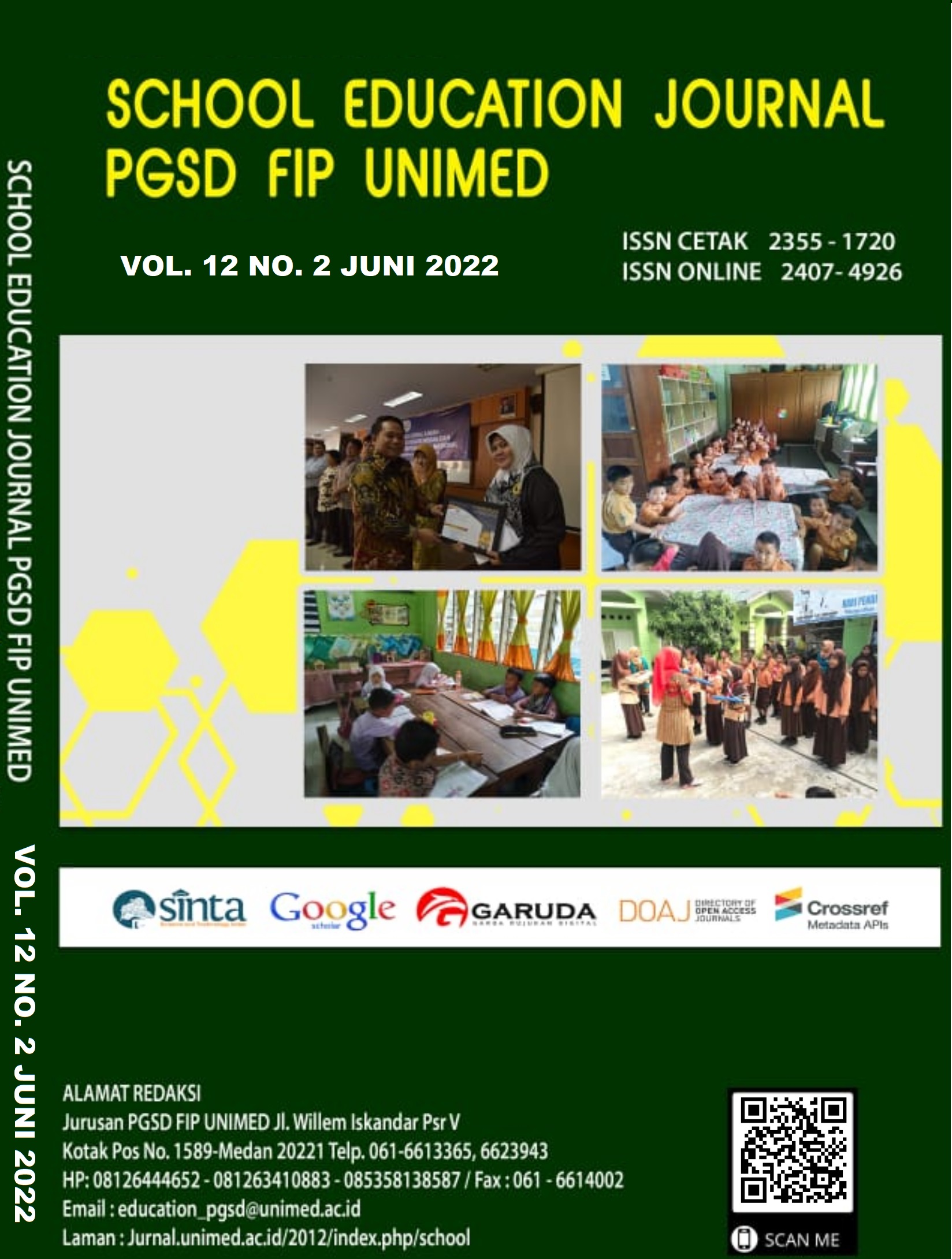
- Cover Image
-
- Downloads
- Published
- 2022-06-28
- Section
- Articles
- License
-
Authors whose manuscripts are approved are approved as follows:
- The publication rights for all journal manuscript materials published/published on the SEJ (School Education Journal) E-Journal site are held by the editorial board with the author's knowledge (moral rights remain with the manuscript authors).
- The formal legal requirements for accessing this electronic digital journal article are subject to the terms of the Creative Commons Attribution-ShareAlike (CC BY-SA 4.0) license, which means that E-Journal SEJ (School Education Journal) has the right to store, transfer media/format, manage in the form of a database, maintain, and publish articles without asking permission from the author as long as the author's name remains as the copyright owner.
- Manuscripts published/published electronically are open access for educational, research, and library purposes.