





ANALISIS DAMPAK PEMBELAJARAN BERBASIS HUMANISTIK TERHADAP PERKEMBANGAN KEPRIBADIAN POSITIF PESERTA DIDIK SEKOLAH DASAR
- Authors
-
-
Sri Wahyuni
Universitas Muhammadiyah Ponorogo
-
Jurianto
Universitas Muhammadiyah Ponorogo
-
- Keywords:
- Humanistic Learning, Positive Character, Elementary School, Student-Centered Learning
- Abstract
-
Elementary school is a crucial stage for shaping students’ character and personality. However, learning practices in schools are still predominantly teacher-centered and focused on cognitive achievement, resulting in less optimal character development. This study aims to analyze the implementation of a humanistic learning approach and its implications for the development of positive character among elementary school students. This research employed a descriptive qualitative approach involving teachers, students, and the school principal as research participants, selected through purposive sampling. Data were collected through interviews, classroom observations, and document analysis, and analyzed using an interactive data analysis model consisting of data reduction, data display, and conclusion drawing. The findings indicate that the implementation of humanistic learning is reflected in student-centered learning practices, the teacher’s role as a facilitator, and the creation of a safe, comfortable, and inclusive learning environment. The humanistic approach contributes positively to students’ personality development at SDN Sukorejo II, including increased self-confidence, responsibility, empathy, creativity, and collaboration skills. Therefore, humanistic learning is considered effective in supporting the holistic development of elementary school students, encompassing cognitive, affective, and social dimensions.
- Downloads
-
Download data is not yet available.
- Author Biographies
- References
-
Amir, N. A., Kamaruddin, S., Sinring, A., & Lutfi, L. (2024). Humanistic Learning Approach in Internalizing Students’ Character in Elementary Schools. DIDAKTIKA : Jurnal Pemikiran Pendidikan, 30(2), 283–289. https://doi.org/10.30587/DIDAKTIKA.V30I2.9012
Damayanti, S., Khairunisa, W., & Fajriani S, N. (2023). Penerapan Model Pembelajaran Vct Dan Implikasinya Terhadap Teori Belajar Humanistik Dalam Membentuk Nilai Moral Peserta Didik. Bhineka Tunggal Ika: Kajian Teori Dan Praktik Pendidikan PKn, 10(2), 183–195. https://doi.org/10.36706/jbti.v10i2.20422
Devi, A. D. (2021). Implementasi Teori Belajar Humanisme dalam Proses Belajar Mengajar Pendidikan Agama Islam. 8, 71–84.
Dinata, F. R. (2021). Pembelajaran Humanistik Dalam Mendorong Pengembangan Afeksi. 7(1), 48–57.
Fanisa Putri Anggraini, Viora Selamata, Arif Rizky, & Sani Safitri. (2025). Pendekatan Humanistik dalam Pembelajaran IPS: Memanusiakan Siswa dalam Proses Pendidikan. SOSIAL : Jurnal Ilmiah Pendidikan IPS, 3(2), 201–216. https://doi.org/10.62383/SOSIAL.V3I2.790
Hafiz, I. Al, Mulia, M., & Saw, N. M. (2025). Integrasi Teori Belajar Humanistik Dengan Pendidikan Islam : Konsep , Implikasi , dan Penerapannya Dalam Pembelajaran Pendahuluan penting dalam pengembangan potensi “ Bacalah dengan ( menyebut ) nama melalui studi pustaka dan dokumentasi , untuk menemukan. 04(02).
Lamberti, M. (2025). Jurnal perseda. Jurnal Perseda, 8(1), 12–21.
Natalia, D. (2025). Penerapan Teori Pembelajaran Humanistik dalam Mengembangkan Kepribadian Siswa Sekolah Dasar melalui Pembelajaran Proyek. Karimah Tauhid, 4(7), 5136–5142. https://doi.org/10.30997/karimahtauhid.v4i7.19553
Rukmi, D.A., Mutiah, T. (2022). PENERAPAN PEMBELAJARAN BERDIFERENSIASI DALAM PERSPEKTIF TEORI BELAJAR HUMANISTIK. Jurnal Pendidikan Dasar Flobamorata, 3(1), 1–11. https://e-journal.unmuhkupang.ac.id/index.php/jpdf%0AVol.
Winata, P., Stiyaningsih, W., & Winata, S. P. (2025). Penerapan Teori Belajar Humanistik Carl Rogers Bagi Siswa dengan Kurikulum Merdeka di Sekolah Dasar. Jurnal Konseling Dan Psikologi Indonesia, 1(3), 240–252.
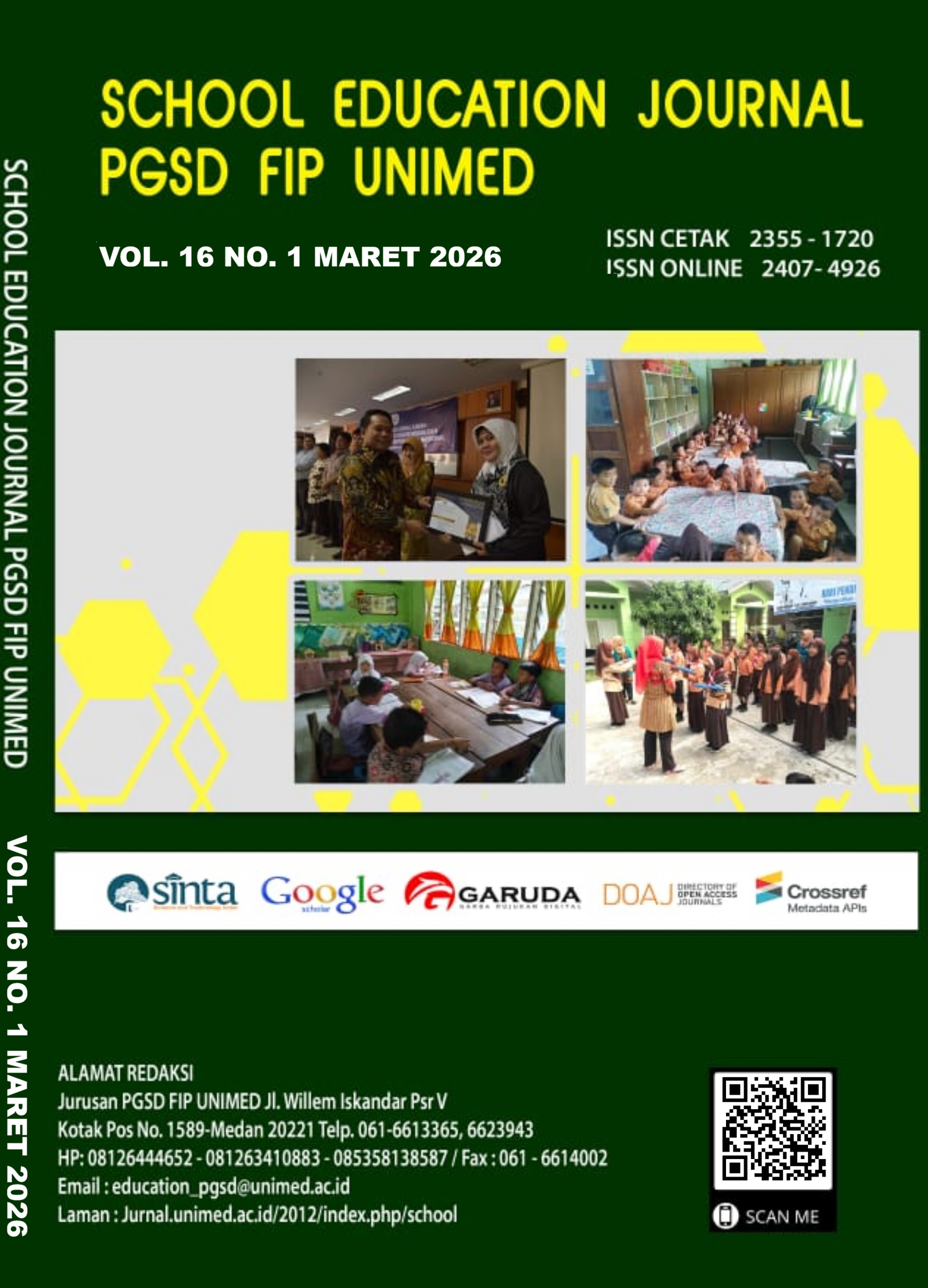
- Cover Image
-
- Downloads
- Published
- 2026-05-05
- Section
- Articles
- License
-
Copyright (c) 2026 SCHOOL EDUCATION JOURNAL PGSD FIP UNIMED

This work is licensed under a Creative Commons Attribution-ShareAlike 4.0 International License.
Authors whose manuscripts are approved are approved as follows:
- The publication rights for all journal manuscript materials published/published on the SEJ (School Education Journal) E-Journal site are held by the editorial board with the author's knowledge (moral rights remain with the manuscript authors).
- The formal legal requirements for accessing this electronic digital journal article are subject to the terms of the Creative Commons Attribution-ShareAlike (CC BY-SA 4.0) license, which means that E-Journal SEJ (School Education Journal) has the right to store, transfer media/format, manage in the form of a database, maintain, and publish articles without asking permission from the author as long as the author's name remains as the copyright owner.
- Manuscripts published/published electronically are open access for educational, research, and library purposes.
