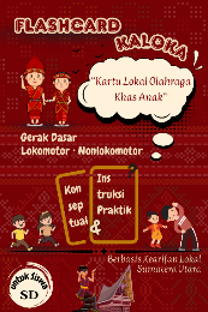
Pengembangan Media Pembelajaran Flashcard “Kaloka” Berbasis Kearifan Lokal Sumatera Utara pada Mata Pelajaran PJOK di Sekolah Dasar
DOI:
https://doi.org/10.24114/72816Abstract
This research aims to determine the validity, practicality, and effectiveness of the KALOKA flashcard learning media based on the local wisdom of North Sumatra in the PJOK subject for students of class V OF SD Negeri 064973 Medan Tembung. The development process was carried out through the Research and Development (R&D) approach with the ADDIE model consisting of five systematic stages, namely Analysis, Design, Development, Implementation, and Evaluation. Validation of the media's feasibility was carried out by material experts, media experts, and educational practitioners, with an average percentage of 96.7%, indicating that the media is in the very feasible category for use in learning. The assessment of the practicality aspect obtained a score of 97.5%, indicating that the media is easy to operate, both by teachers and students, and supports an effective and conducive learning process. The visualization of basic movements presented in the media allows the delivery of basic locomotor and non-locomotor movement materials in a visual, educational, and interesting manner, thereby encouraging student independence in the learning process. The effectiveness test was conducted through an analysis of learning outcomes using a pre-test and post-test, with an average pre-test score of 54.82% and a post-test score of 86.43%. This significant improvement was supported by the N-Gain calculation of 0.7147, which is considered high. Based on these results, the learning media was declared valid, as it met the criteria for appropriate content, appearance, and functionality based on expert assessments; practical, as it could be used optimally by users in real-life learning contexts without significant obstacles; and effective, as it had a significant positive impact on improving student learning outcomes in basic locomotor and non-locomotor movement materials. Therefore, this media has the potential for wider implementation and development in other materials and educational levels.
Downloads
References
Aurora, P.I., & Simanihuruk, L. (2024). “Pengembangan Media Flashcard Berbasis Aplikasi Canva Pada Siswa Kelas IV SDN 104231 Batang Kuis” IJEB: Indonesian Journal Education Basic, 2 (2), 240-247.
Bikalawan, S.S., dkk. (2024). “Media Pembelajaran Flash Card dalam Pendidikan Jasmani Meningkatkan Keterampilan Gerak Lokomotor Siswa” Jurnal Tantangan, 57, 80-87.
Gandamana, A., & Nst, S.A.R. (2020). “Pengembangan Media Pembelajaran Fun Thinkers Book Berbasis Scientific Pada Tema 4 Berbagai Pekerjaan Subtema 1 Jenis-Jenis Pekerjaan Kelas IV DI SDN 060912 Medan Denai T.A 2020/2021” Jurnal Keluarga Sehat Sejahtera, 18 (1), 36-45.
Hayya, A.R. (2023). Skripsi. Pengembangan Media Pembelajaran Flashcard Materi Bentuk Dan Fungsi Bagian Tumbuhan Siswa Kelas IV SDN Lirboyo 1 Kota Kediri. FKIP: UN PGRI Kediri.
Sania, F.N., dkk. (2025). “Pengembangan Media Flashcard Berbasis Kearifan Lokal Kota Palembang Materi Makananku, Budayaku Kelas II SD” Pendas: Jurnal Ilmiah Pendidikan Dasar, 10 (2), 494-503.
Shafa, I., dkk. (2022). “Pengembangan Media Flashcard Materi Pahlawanku untuk Meningkatkan Hasil Belajar Siswa Sekolah Dasar” Jurnal Basicedu, 6 (2), 2754-2761.
Sinaga, A.R.C., dkk. (2025). “Pengembangan Media Pembelajaran Bahasa Inggris Flash Card Comic Kelas IV SDN 060872 Medan” Jurnal Tematik, 14 (2), 139-145.
Supriyaddin, dkk. (2024). “Pengembangan Media Pembelajaran berbasis Flash Card untuk Meningkatkan Hasil belajar Siswa Kelas V” Jurnal Evaluasi dan Kajian Strategis Pendidikan Dasar, 1 (2), 57-63.
Widiyawanto, D.S., & Angin, L.M.P. (2025). “Pengembangan Media Pembelajaran Bhinneka Boardgame (BhinBo) untuk Meningkatkan Hasil Belajar Materi Keberagaman Budaya Kelas IV SDN 101912 Pagar Merbau” JIPDAS: Jurnal Ilmiah Pendidikan Dasar, 5 (4), 3772-3790.
Downloads
Published
Issue
Section
License
Copyright (c) 2026 Mufidatul Husna

This work is licensed under a Creative Commons Attribution-ShareAlike 4.0 International License.
Authors who publish with this journal agree to the following terms:
Authors retain copyright and grant the journal right of first publication with the work simultaneously licensed under a Creative Commons Attribution 4.0 International that allows others to share the work with an acknowledgement of the work's authorship and initial publication in this journal.
Authors are able to enter into separate, additional contractual arrangements for the non-exclusive distribution of the journal's published version of the work (e.g., post it to an institutional repository or publish it in a book), with an acknowledgement of its initial publication in this journal.
Authors are permitted and encouraged to post their work online (e.g., in institutional repositories or on their website) prior to and during the submission process, as it can lead to productive exchanges, as well as earlier and greater citation of published work.
Deprecated: Implicit conversion from float-string "-118.3465" to int loses precision in /var/www/html/2012/plugins/generic/pflPlugin/PflPlugin.php on line 132