Analisis Pembelajaran Volume Balok Berdasarkan Teori Belajar Kognitif di Kelas V Sekolah Dasar
DOI:
https://doi.org/10.24114/jmpsd.v4i1.77848Keywords:
cognitive learning theory, elementary mathematics, learning documentation, rectangular prism volumeAbstract
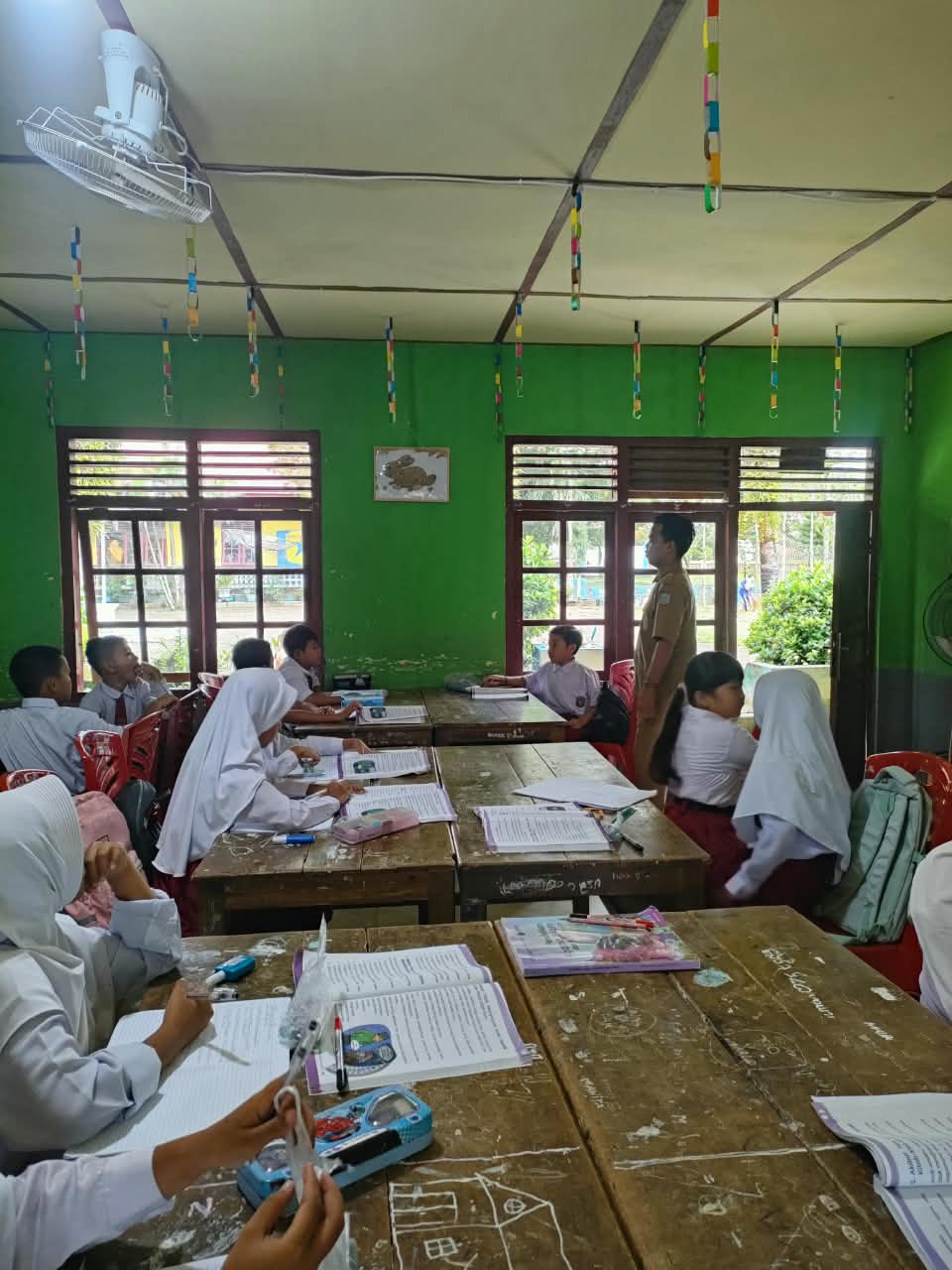
Learning the volume of rectangular prisms requires elementary students to connect length, width, height, cubic units, and multiplication. This article describes the available documentation of a Grade V lesson at a public elementary school in Merangin Regency, Jambi Province, and examines its relationship with cognitive learning theory. The study adopts a documentation-based descriptive approach using classroom photographs, a lesson video specifically addressing rectangular-prism volume, and the lesson plan included in the mini-research report. The analysis identifies information visible in the documents, distinguishes documented classroom conditions from planned instructional activities, and interprets the materials through Ausubel’s meaningful learning, Bruner’s enactive–iconic–symbolic representations, and Piaget’s cognitive development perspective. The documentation indicates the use of a board, ruler, laptop, projector, and teaching aids. The class context comprised 24 students; however, no individual-level evidence was available in the form of structured observation records, interview transcripts, student work, or assessment results. Therefore, the article does not draw conclusions about students’ understanding or instructional effectiveness. The analysis highlights the importance of connecting concrete models, visual representations, and symbolic volume formulas, while emphasizing the need for systematic process and outcome data in future research.
Downloads
References
Agusti, F. A., Salmaini, S., Ridha, M., Alfarabby, M. T., & Amsari, D. (2026). Pengembangan e-modul interaktif berdasarkan prinsip cognitive load theory untuk pembelajaran materi kubus dan balok. AKSIOMA: Jurnal Program Studi Pendidikan Matematika, 15(3), 1594–1608. https://doi.org/10.24127/ajpm.v15i3.17119
Ausubel, D. P. (1968). Educational psychology: A cognitive view. Holt, Rinehart and Winston.
Azzahra, A. F., Rintayati, P., & Triyani, S. (2026). Efektivitas model problem based learning berbantuan GeoGebra terhadap pemahaman konsep volume kubus dan balok kelas V sekolah dasar. Didaktika Dwija Indria, 14(6). https://doi.org/10.20961/ddi.v14i6.126031
Bruner, J. S. (1966). Toward a theory of instruction. Harvard University Press.
Creswell, J. W., & Poth, C. N. (2018). Qualitative inquiry and research design: Choosing among five approaches (4th ed.). SAGE Publications.
Đokić, O. J., Dabić Boričić, M. M., & Jelić, M. S. (2022). Comparing ICT with physical manipulative supported learning of 3D geometry in elementary school. Journal of Educational Computing Research, 59(8), 1623–1654. https://doi.org/10.1177/07356331211001319
Farista, M. I., Ilma Indra Putri, R., & Hapizah, H. (2022). Analisis pilot experiment pada desain pembelajaran materi volume balok menggunakan pendekatan Model Eliciting Activities (MEAs). Jurnal Pendidikan Matematika RAFA, 8(2), 128–143. https://doi.org/10.19109/jpmrafa.v8i2.14959
Faujiah, Y., Karlimah, & Irawan, T. M. I. A. (2026). Analisis kesiapan kognitif siswa kelas IV terhadap konsep volume bangun ruang berdasarkan prinsip hukum kekekalan volume. Jurnal Pendidikan Dasar, 17(1), 147–157. https://doi.org/10.21009/jpd.v17i1.67893
Finanda, T. E., Habibie, R. K., Wiryanto, W., Abidin, Z., & Zuliyawati, E. M. (2026). Visualizing volume through unit cubes: The effect of Tinkercad 3D design on elementary students’ conceptual understanding. Paedagogia, 29(3), 434–450. https://doi.org/10.20961/paedagogia.v29i3.127184
Handayani, T. L., Lidinillah, D. A. M., & Apriani, I. F. (2026). Desain didaktis volume kubus dan balok untuk meningkatkan kemampuan numerasi siswa kelas IV. Pendas: Jurnal Ilmiah Pendidikan Dasar, 11(3), 358–365. https://doi.org/10.23969/jp.v11i03.55729
Lastini, F., Haryanti, S., Sumardjoko, B., & Fauziati, E. (2024). Implementasi teori perkembangan kognitif Bruner pada pembelajaran matematika tentang perkalian di kelas II sekolah dasar. Pendas: Jurnal Ilmiah Pendidikan Dasar, 9(3), 478–494. https://doi.org/10.23969/jp.v9i03.16003
Lestari, D. A., Isrok’atun, & Syahid, A. A. (2026). Effect of 3D unit cube board media on students’ understanding of the concepts of the volume of a cube and a rectangular prism. Kognitif: Jurnal Riset HOTS Pendidikan Matematika, 6(3), 1035–1052. https://doi.org/10.51574/kognitif.v6i3.5354
Mayer, R. E. (2009). Multimedia learning (2nd ed.). Cambridge University Press.
McDougal, E., Silverstein, P., Treleaven, O., Jerrom, L., Gilligan-Lee, K., Gilmore, C., & Farran, E. K. (2024). Assessing the impact of LEGO® construction training on spatial and mathematical skills. Developmental Science, 27(2), Article e13432. https://doi.org/10.1111/desc.13432
Piaget, J. (1970). Science of education and the psychology of the child. Orion Press.
Pinilla, R. K. (2024). Spatial reasoning in mathematics standards: Identifying how early elementary educators are systematically supported to teach spatial skills. Frontiers in Education, 9, Article 1407388. https://doi.org/10.3389/feduc.2024.1407388
Ponte, R., Viseu, F., Neto, T. B., & Aires, A. P. (2023). Revisiting manipulatives in the learning of geometric figures. Frontiers in Education, 8, Article 1217680. https://doi.org/10.3389/feduc.2023.1217680
Purnomo, Y. W., Shahrill, M., Pandansari, O., Susanti, R., & Winarni, W. (2022). Cognitive demands on geometrical tasks in Indonesian elementary school mathematics textbook. Jurnal Elemen, 8(2), 466–479. https://doi.org/10.29408/jel.v8i2.5235
Puspita, N. A. (2024). The effect of probing prompting learning model with geoboard media on fourth-grade mathematics learning outcomes. International Journal of Elementary Education, 8(4), 726–733. https://doi.org/10.23887/ijee.v8i4.91665
Putri, A. F. H., Sulistyowati, D. R., Fittari, M., Julianto, J., & Wiryanto, W. (2024). Analisis metakognisi peserta didik kelas V sekolah dasar dalam memecahkan masalah matematika bangun ruang dalam perspektif teori perkembangan kognitif Jean Piaget. Sekolah Dasar: Kajian Teori dan Praktik Pendidikan, 33(1), 26–39. https://doi.org/10.17977/um009v33i12024p26-39
Rupnow, T. J., O’Dell, J. R., Barrett, J. E., Cullen, C. J., Clements, D. H., Sarama, J., & Rutherford, G. (2022). Children’s construction of a volume calculation algorithm for a rectangular prism with a dynamic virtual manipulative. The Journal of Mathematical Behavior, 67, Article 100998. https://doi.org/10.1016/j.jmathb.2022.100998
Saccardo, F., Decarli, G., Missagia, V. I., Andrao, M., Gini, F., Zancanaro, M., & Franchin, L. (2024). Emotions and interactive tangible tools for math achievement in primary schools. Frontiers in Psychology, 15, Article 1440981. https://doi.org/10.3389/fpsyg.2024.1440981
Schenck, K. E., & Nathan, M. J. (2024). Navigating spatial ability for mathematics education: A review and roadmap. Educational Psychology Review, 36, Article 90. https://doi.org/10.1007/s10648-024-09935-5
Siller, H.-S., & Ahmad, S. (2024). The effect of concrete and virtual manipulative blended instruction on mathematical achievement for elementary school students. Canadian Journal of Science, Mathematics and Technology Education, 24, 229–266. https://doi.org/10.1007/s42330-024-00336-y
Zulaiha, E., Anshor, A. S., & Humairah, E. (2024). Pengaruh media visual tiga dimensi terhadap hasil belajar matematika pada materi volume kubus dan balok kelas V SD. EduInovasi: Journal of Basic Educational Studies, 4(3), 1752–1767. https://doi.org/10.47467/edu.v4i3.4773
Downloads
Published
Issue
Section
License
Copyright (c) 2026 Dani Saputra, Otang Kurniaman

This work is licensed under a Creative Commons Attribution 4.0 International License.
Authors who publish with this journal agree to the following terms:
Authors retain copyright and grant the journal right of first publication with the work simultaneously licensed under a Creative Commons Attribution 4.0 International that allows others to share the work with an acknowledgement of the work's authorship and initial publication in this journal.
Authors are able to enter into separate, additional contractual arrangements for the non-exclusive distribution of the journal's published version of the work (e.g., post it to an institutional repository or publish it in a book), with an acknowledgement of its initial publication in this journal.
Authors are permitted and encouraged to post their work online (e.g., in institutional repositories or on their website) prior to and during the submission process, as it can lead to productive exchanges, as well as earlier and greater citation of published work.