





PENGARUH KEBIASAAN BERPIKIR TERHADAP KEMAMPUAN PEMECAHAN MASALAH MATEMATIS SISWA PADA MATERI BANGUN DATAR KELAS III
- Authors
-
-
Dewi Sinta
ISBI SINGKAWANG
-
Mariyam
ISBI Singkawang
-
Buyung
ISBI Singkawang
-
- Keywords:
- Thinking Habits, Mathematical Problem Solving Ability, Student
- Abstract
-
This study aims: (1) To describe students' thinking habits on the material of flat shapes of grade III of Singkawang State Elementary School 25. (2) To describe students' mathematical problem-solving abilities on the material of flat shapes of grade III of Singkawang State Elementary School 25. (3) To determine whether or not there is an influence of thinking habits on students' mathematical problem-solving abilities on the material of flat shapes of grade III of Singkawang State Elementary School 25. The type of research used is quantitative research, with a simple regression approach. Data collection techniques used in this study were non-test and test techniques. The data analysis techniques used were average analysis, percentage and simple regression. The results of the study showed that: (1) Students' thinking habits are classified as very high with an average score of 87. (2) Students' mathematical problem-solving abilities on flat shapes are classified as high with an average of 78. (3) There is an influence of thinking habits on students' mathematical problem solving abilities on the material of flat shapes in class III of Singkawang 25 Elementary School with a positive category.
- Downloads
-
Download data is not yet available.
- Author Biographies
- References
-
Agustami, Aprida, V., & Pramita, A. 2021. Analisis Kemampuan Pemecahan Masalah Matematis Siswa dalam Menyelesaikan Soal Materi Lingkaran. Jurnal Prodi Pendidikan Matematika (JPMM), 3(1), 224–231.
Buyung, B., & Sumarli, S. (2021). Analisis kesulitan siswa dalam menyelesaikan soal cerita berbasis kemampuan pemecahan masalah. Variabel, 4(2), 61-66.
Fathonah, Sirin. 2019. Perbedaan Kebiasaan Berpikir Matermatis dan Kemampuan Berpikir Kritis Siswa Sekolah Dasar Antara Pembelajaran Dengan Model Amora Dan Konvensional. Universitas Pendidikan Indonesia repository.upi.edu ¦ perpustakaan.upi.edu
Hendriana dan Soemarmo. 2014. Penilaian Pembelajaran Matematika. Bandung: Refika Aditama.
Mariyam, M., Prihatiningtyas, N. C., & Wahyuni, R. (2018). Pengembangan Kemampuan Pemecahan Masalah Matematis Siswa Pada Materi Pertidaksamaan Linier Satu Variabel Melalui Model Problem Based Learning Berbantuan Modul. JPMI (Jurnal Pendidikan Matematika Indonesia), 3(2), 66-73.
Nurfatanah, Rusmono, & Nurjannah. 2018. Kemampuan Pemecahan Masalah Matematika Siswa Sekolah Dasar, dalam Prosiding Seminar dan Diskusi Nasional Pendidikan Dasar,546–551
Ramlah R dan Maya, R. 2018. Implementasi Pendekatan Problem Solving Dalam Pencapaian Kemampuan berpikir Kreatif, Matematis Serta Habits Of Mind Siswa MTs. Jurnal Penelitian Dan Pembelajaran Matematika, 11 (1)
Rukaesih A, dkk. 2015. Metode Penelitian Pendidikan. Jakarta: Rajawali Pers.
Sugiyono. 2014. Metode Penelitian Kuantitatif, Kualitatif dan R&D. Bandung: Alfabeta.
Sugiyono. 2017. Metode Penelitian Kuantitatif, Kualitatif dan R&D. Bandung: Alfabeta.
Suherli. 2015. Menulis Karangan Ilmiah. Depok: Arya Duta
Sunyoto. 2014. Analisis Data Penelitian Kualitatif. Jakarta: Raja Grafindo Persada.
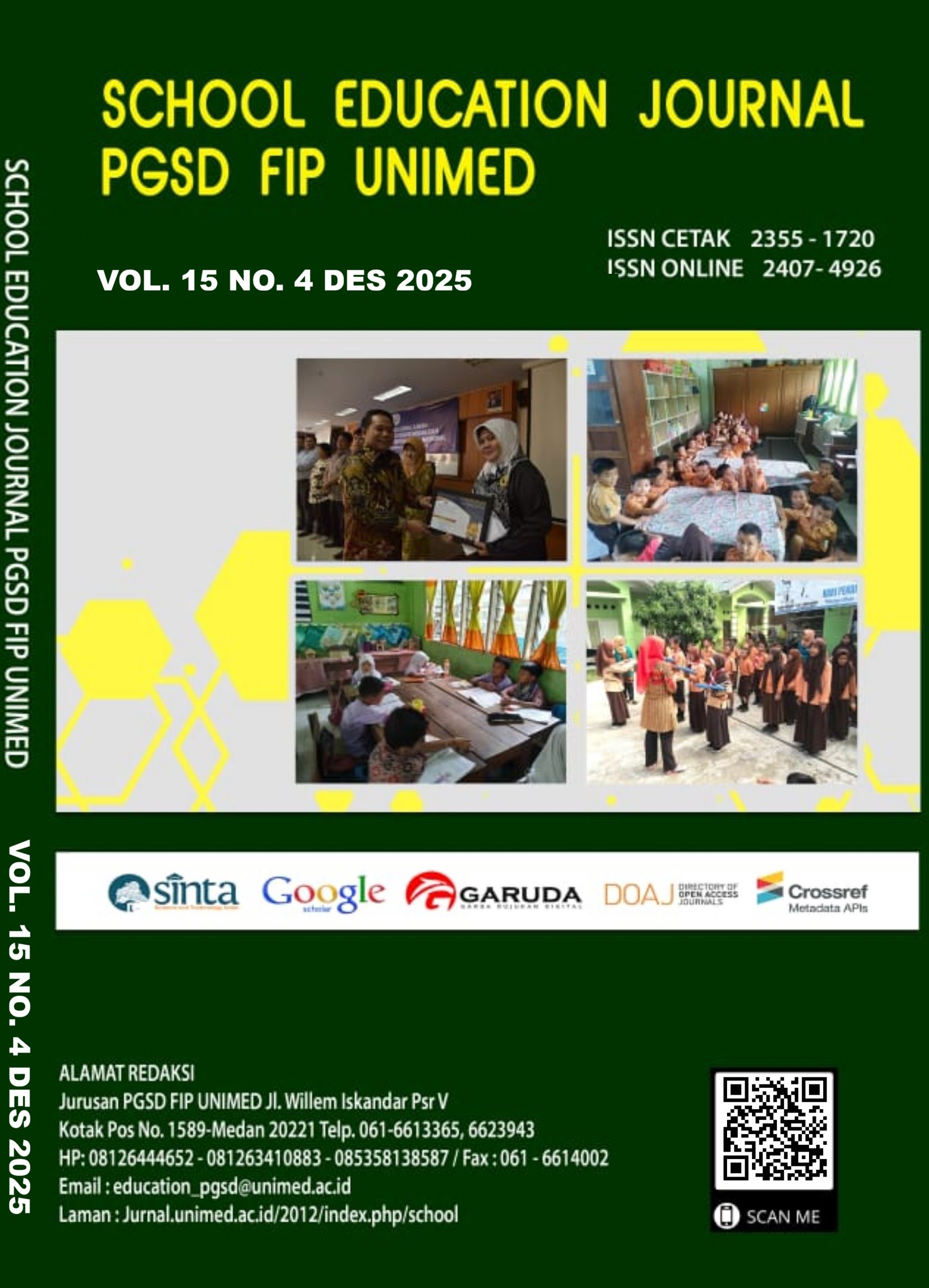
- Cover Image
-
- Additional Files
- Published
- 2025-12-29
- Section
- Articles
- License
-
Copyright (c) 2025 SCHOOL EDUCATION JOURNAL PGSD FIP UNIMED

This work is licensed under a Creative Commons Attribution-ShareAlike 4.0 International License.
Authors whose manuscripts are approved are approved as follows:
- The publication rights for all journal manuscript materials published/published on the SEJ (School Education Journal) E-Journal site are held by the editorial board with the author's knowledge (moral rights remain with the manuscript authors).
- The formal legal requirements for accessing this electronic digital journal article are subject to the terms of the Creative Commons Attribution-ShareAlike (CC BY-SA 4.0) license, which means that E-Journal SEJ (School Education Journal) has the right to store, transfer media/format, manage in the form of a database, maintain, and publish articles without asking permission from the author as long as the author's name remains as the copyright owner.
- Manuscripts published/published electronically are open access for educational, research, and library purposes.
