Analisis Capaian Hasil Projek Penguatan Profil Pelajar Pancasila Pjok Siswa Kelas IV SD
DOI:
https://doi.org/10.24114/jmpsd.v3i6.76679Keywords:
Analysis, Project, Pancasila, Kijang JayaAbstract
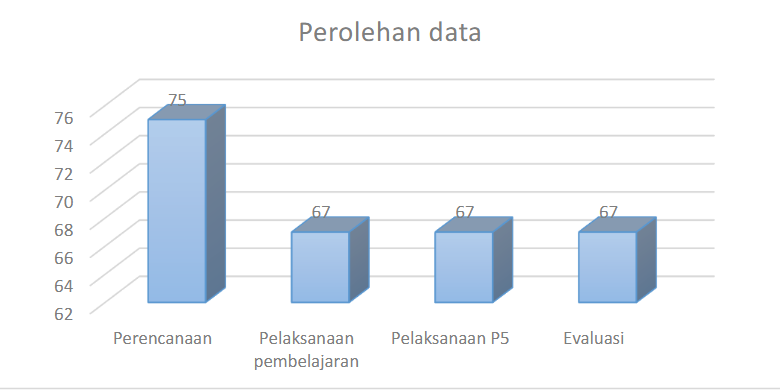
This study aims to analyze the achievement outcomes of the "Project to Strengthen the Pancasila Student Profile" (P5) within the Physical Education (PJOK) curriculum for fourth-grade students at UPT SDN 009 Kijang Jaya. A quantitative research design was employed, analyzing assessments of physical skills and student engagement to identify concrete improvements in motor skills and fitness. Qualitative data from reflective journals and observations were analyzed to understand changes in students' attitudes, values, and behaviors. The results indicate varied achievement levels across the stages of the P5 project within the PJOK curriculum. At the planning stage, achievement reached 75%, indicating that the planning of PJOK instruction—including the curriculum and supporting materials—was executed quite well; this encompassed clear learning objectives, appropriate content, effective teaching strategies, and integrated assessment. However, achievement levels at the implementation, P5 execution, and evaluation stages were 67% each. The study concludes that the average achievement across all indicators was 69%, a level categorized as "quite good." Although the implementation of P5 within PJOK instruction has proceeded well, certain aspects require improvement to achieve more optimal results. Therefore, sustained efforts are needed to refine and develop areas that are currently lacking, in order to meet higher educational goals and ensure the more effective strengthening of the Pancasila student profile.
Downloads
References
Edukatif, B., & Alam, B. (2018). Jurnal Pendidikan Jasmani dan Olahraga. 3(1), 41–51. https://doi.org/10.17509/jpjo.v3i1.10612
Emzir. (2012). Metodologi Penelitian Kualitatif Analisis Data. Rajawali.
Izzaty, R. E. (2008). Perkembangan Peserta Didik. UNY Press.
Kusuma Wardani Soekardi & Fakhruddin. (2017). Kajian Pendidikan Jasmani Olahraga dan Kesehatan di Pondok Pesantren Askhabul Kahfi Kota Semarang. Journal of Physical Education and Sports, 6(1), 57–65. http://journal.unnes.ac.id/sju/index.php/jpes
Maharani, A. I., Isharoh, & Putri, P. A. (2023). Program P5 sebagai Implementasi Kurikulum Merdeka: Faktor Penghambat dan Upayanya. Jurnal Pendidikan, Bahasa, Sastra, Seni, Budaya, Dan Sosial Humaniora, 1(2), 176–187. https://doi.org/10.59024/atmosfer.v1i2.153
Mahirah, B. (2017). Evaluasi Belajar Peserta Didik (siswa). Jurnal Idaarah, 1(2), 257–267.
Maruti, S., Hanif, M., Budyartati, S., Huda, N., Kusuma, W., & Khoironi, M. (2023). Implementasi Projek Penguatan Profil Pelajar Pancasila ( P5 ) pada Jenjang Sekolah Dasar. Jurnal Abdimas Mandalika, 2(2), 85–90.
Mashud, M., Pebriyandi, P., Fadillah, M., & Ridha, S. (2024). Perwujudan Profil Pelajar Pancasila dalam Mata Pelajaran Pendidikan Jasmani: Article Review. Jendela Olahraga, 9(1), 179–193. https://doi.org/10.26877/jo.v9i1.17678
Nugraha, G. B. M., Artanayasa, I. W., & Wijaya, M. A. (2018). Pengembangan Media Pembelajaran PJOK Berbasis Kartu Gerak Aktivitas Pengembangan untuk Siswa Kelas XI SMA Negeri Sukasada. E_Journal Pendidikan Jasmani, Kesehatan Dan Rekreasi, 9(1).
Satria, R., Adiprima, P., Wulan, K. S., & Harjatanaya, T. Y. (2022). Projek Penguatan Profil Pelajar Pancasila. In Kemdikbud Ristek.
Sugiyono. (2016). Metode Penelitian dan Pengembangan (research and development). Alfabeta.
Tohir, M. (2019). Empat Pokok Kebijakan Merdeka Belajar. https://doi.org/10.31219/osf.io/67rcq
Vahlepi, S., & Tersta, F. W. (2021). Implementasi Model Pembelaaran berbasis Case Method dan Project Based Learning dalam rangka mengakomodir Higher Order Thinking Skill mahasiswa dalam Mata Kuliah Psikologi Pendidikan Bahasa Arab di Masa Pandemi. 5(3), 10153–10159.
Downloads
Published
Issue
Section
License
Copyright (c) 2026 Ilman Pijeiri

This work is licensed under a Creative Commons Attribution-ShareAlike 4.0 International License.
Authors who publish with this journal agree to the following terms:
Authors retain copyright and grant the journal right of first publication with the work simultaneously licensed under a Creative Commons Attribution 4.0 International that allows others to share the work with an acknowledgement of the work's authorship and initial publication in this journal.
Authors are able to enter into separate, additional contractual arrangements for the non-exclusive distribution of the journal's published version of the work (e.g., post it to an institutional repository or publish it in a book), with an acknowledgement of its initial publication in this journal.
Authors are permitted and encouraged to post their work online (e.g., in institutional repositories or on their website) prior to and during the submission process, as it can lead to productive exchanges, as well as earlier and greater citation of published work.
Deprecated: Implicit conversion from float-string "-118.3465" to int loses precision in /var/www/html/2012/plugins/generic/pflPlugin/PflPlugin.php on line 132