THE ROLE OF TEACHERS’ TEACHING STYLES IN STUDENTS’ MOTIVATION TO LEARN MATHEMATICS IN ELEMENTARY SCHOOL
DOI:
https://doi.org/10.24114/jmpsd.v2i3.72337Keywords:
teaching style, learning motivation, mathematics learningAbstract
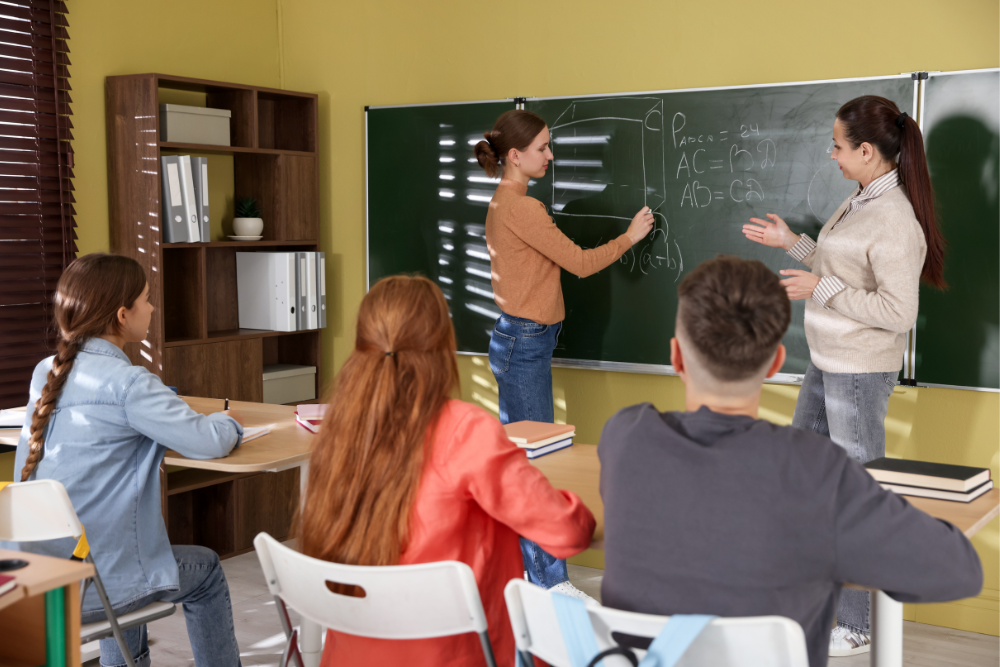
Education quality is closely related to the effectiveness of teachers’ teaching styles in the learning process. This study aims to explore the role of teachers’ teaching styles in enhancing students’ motivation to learn mathematics in elementary school. The research employed a descriptive qualitative approach. Data were collected through classroom observations and in-depth interviews with a fourth-grade teacher and eight fourth-grade students at SD Negeri 060792 Medan Timur. The findings indicate that teaching styles that actively involve students, consider students’ psychological conditions, and connect mathematical concepts to real-life situations significantly contribute to increased learning motivation. In addition, positive teacher–student interactions and the creation of a safe and supportive classroom environment encourage students to participate more actively and confidently in mathematics learning. The use of contextual teaching approaches, group practices, and interactive activities was found to reduce students’ boredom and foster independent learning. This study concludes that appropriate and varied teaching styles play an important role in motivating elementary school students to learn mathematics. Therefore, teachers are encouraged to apply flexible and student-centered teaching styles to create meaningful and engaging mathematics learning experiences.
References
Cahya, L. (2020, November). Pengaruh gaya mengajar guru terhadap motivasi belajar siswa kelas III SDN Ngebruk 01 Kecamatan Poncokusumo Kabupaten Malang. Prosiding Seminar Nasional PGSD UNIKAMA, 4(1), 461–471.
Fakar, M. H. W. A. (2024). Pengaruh gaya mengajar guru terhadap prestasi belajar siswa. Jurnal Pendidikan Guru, 5(3).
Hartati, H., Kadir, A., & Agus, I. (2023). Pengaruh gaya mengajar guru terhadap motivasi belajar peserta didik kelas tinggi sekolah dasar. Diniyah: Jurnal Pendidikan Dasar, 4(1), 1–19.
Purwati, I., & Fauziati, E. (2022). Pendidikan karakter religius sekolah dasar dalam perspektif filsafat idealisme. Elementa: Jurnal Pendidikan Guru Sekolah Dasar, 4(1).
Rahmah, H., & Pardi, H. H. (2023). The influence of teacher’s teaching style on students’ mathematics learning outcomes. Journal of Math Tadris, 3(1), 1–15.
Sinaga, D. Y., Saragih, H., Manullang, A., Manurung, L., Sianipar, P., & Purba, P. (2024). Pengaruh gaya mengajar terhadap motivasi belajar matematika siswa kelas III SD Negeri 091538 Hutabayu Raja. Innovative: Journal of Social Science Research, 9058–9070.
Van Gobel, I., Panigoro, M., & Sudirman, S. (2023). Pengaruh beasiswa terhadap motivasi belajar mahasiswa Pendidikan Ekonomi angkatan 2019 Universitas Negeri Gorontalo. Journal of Economic and Business Education, 1(2), 93–100.
Downloads
Published
Issue
Section
License
Copyright (c) 2025 Sinthya Dwi Putri Manik, Berliana Y. Sianturi, Atiqatul Hasnah, Anestasya Amanda Sitepu, Elvi Mailani

This work is licensed under a Creative Commons Attribution-ShareAlike 4.0 International License.
Authors who publish with this journal agree to the following terms:
Authors retain copyright and grant the journal right of first publication with the work simultaneously licensed under a Creative Commons Attribution 4.0 International that allows others to share the work with an acknowledgement of the work's authorship and initial publication in this journal.
Authors are able to enter into separate, additional contractual arrangements for the non-exclusive distribution of the journal's published version of the work (e.g., post it to an institutional repository or publish it in a book), with an acknowledgement of its initial publication in this journal.
Authors are permitted and encouraged to post their work online (e.g., in institutional repositories or on their website) prior to and during the submission process, as it can lead to productive exchanges, as well as earlier and greater citation of published work.