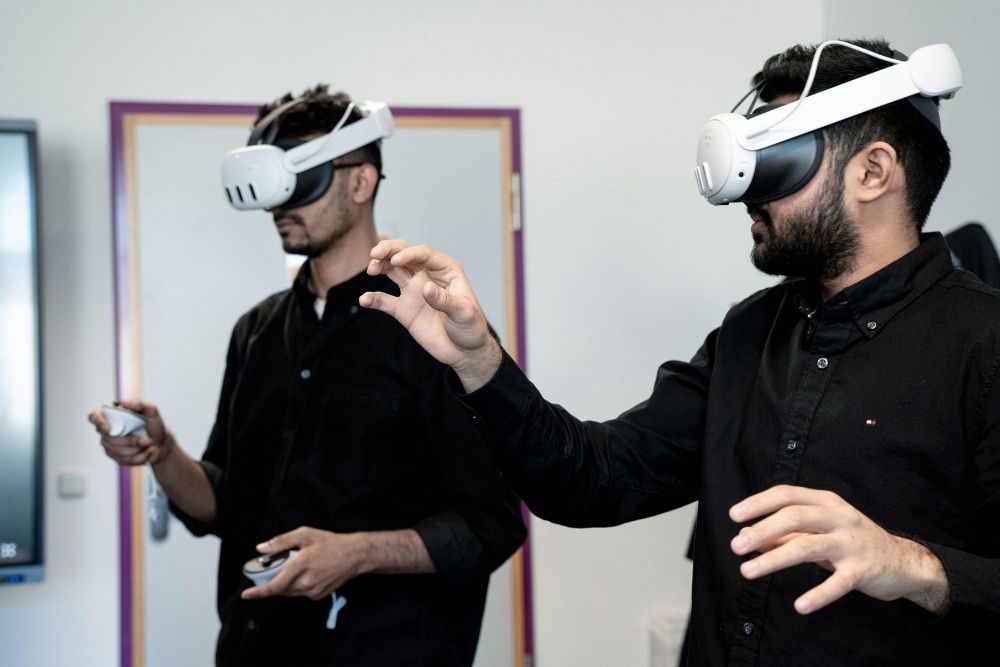
THE USE OF VIRTUAL REALITY IN AVIATION EDUCATION
EVALUATION OF EFFECTIVENESS, CHALLENGES, AND SKILL TRANSFER THROUGH A SYSTEMATIC LITERATURE REVIEW
DOI:
https://doi.org/10.24114/jmpsd.v3i3.70776Keywords:
Virtual Reality, Aviation Education, Technical Skills, Non-Technical Skills, Systematic Literature Review, Skills TransferAbstract
This research aims to evaluate the use of Virtual Reality (VR) technology in aviation education, with a focus on improving technical and non-technical skills, implementation challenges, and transferring skills to the real world. The method used is the Systematic Literature Review (SLR), which collects and analyzes scientific articles related to the use of VR in flight training. The results show that VR is effective in improving technical skills, such as aircraft navigation and aircraft control, as well as non-technical skills, such as decision-making and team communication in emergency situations. However, the main challenges facing aviation education institutions are cost and infrastructure, although VR provides significant benefits in terms of training flexibility and reduced reliance on physical simulators. Additionally, while VR improves skills in simulation, the transfer of those skills to the real world still requires further evaluation. In conclusion, VR has great potential to optimize flight training, but it requires integration with hands-on training in the field to ensure effective skill transfer. The study also suggests further research to develop more adaptive and effective VR training models in the context of aviation education.
References
Bernard, F., Bonnardel, X., Paquin, R., Petit, M., Marandel, K., Bordin, N., & Bonnardel, F. (2022). Digital simulation tools in aviation maintainability training. Computer Applications in Engineering Education, 30(2), 384–395. https://doi.org/10.1002/cae.22461
Bernard, F., Bonnardel, X., Paquin, R., Petit, M., Marandel, K., Bordin, N., & Bonnardel, F. (2022). Digital simulation tools in aviation maintainability training. Computer Applications in Engineering Education, 30(2), 384–395. https://doi.org/10.1002/cae.22461
Bornheimer, L. A., Li Verdugo, J., Humm, L., Steacy, C., Krasnick, J., Goldstein Grumet, J., Aikens, J. E., Gold, K. J., Hiltz, B., & Smith, M. J. (2024). Computerized Suicide Prevention Clinical Training Simulations: A Pilot Study. Research on Social Work Practice, 34(2), 182–193. https://doi.org/10.1177/10497315231161563
Masiello, I., Herault, R., Mansfeld, M., & Skogqvist, M. (2022). Simulation-Based VR Training for the Nuclear Sector—A Pilot Study. Sustainability (Switzerland), 14(13), 1–14. https://doi.org/10.3390/su14137984
Philip, N., Ali, K., Duggal, M., Daas, H., & Nazzal, H. (2023). Effectiveness and Student Perceptions of Haptic Virtual Reality Simulation Training as an Instructional Tool in Pre-Clinical Paediatric Dentistry: A Pilot Pedagogical Study. International Journal of Environmental Research and Public Health, 20(5). https://doi.org/10.3390/ijerph20054226
Rizvi, S. A. Q., Rehman, U., Cao, S., & Moncion, B. (2025). Exploring technology acceptance of flight simulation training devices and augmented reality in general aviation pilot training. Scientific Reports, 15(1), 1–16. https://doi.org/10.1038/s41598-025-85448-7
Somerville, A., Lynar, T., Joiner, K., & Wild, G. (2024). Use of Simulation for Pre-Training of Drone Pilots. Drones, 8(11), 1–14. https://doi.org/10.3390/drones8110640
Strand, A., Gorton, P. R., & Brathen, K. (2025). Modeling Air Combat Behavior for Simulation-Based Pilot Training: A Survey of Machine Learning Approaches. IEEE Access, 13(June), 113666–113685. https://doi.org/10.1109/ACCESS.2025.3580279
Downloads
Published
Issue
Section
License
Copyright (c) 2025 Rahmat, Hasan Maksum, Dony Novaliendry

This work is licensed under a Creative Commons Attribution-ShareAlike 4.0 International License.
Authors who publish with this journal agree to the following terms:
Authors retain copyright and grant the journal right of first publication with the work simultaneously licensed under a Creative Commons Attribution 4.0 International that allows others to share the work with an acknowledgement of the work's authorship and initial publication in this journal.
Authors are able to enter into separate, additional contractual arrangements for the non-exclusive distribution of the journal's published version of the work (e.g., post it to an institutional repository or publish it in a book), with an acknowledgement of its initial publication in this journal.
Authors are permitted and encouraged to post their work online (e.g., in institutional repositories or on their website) prior to and during the submission process, as it can lead to productive exchanges, as well as earlier and greater citation of published work.