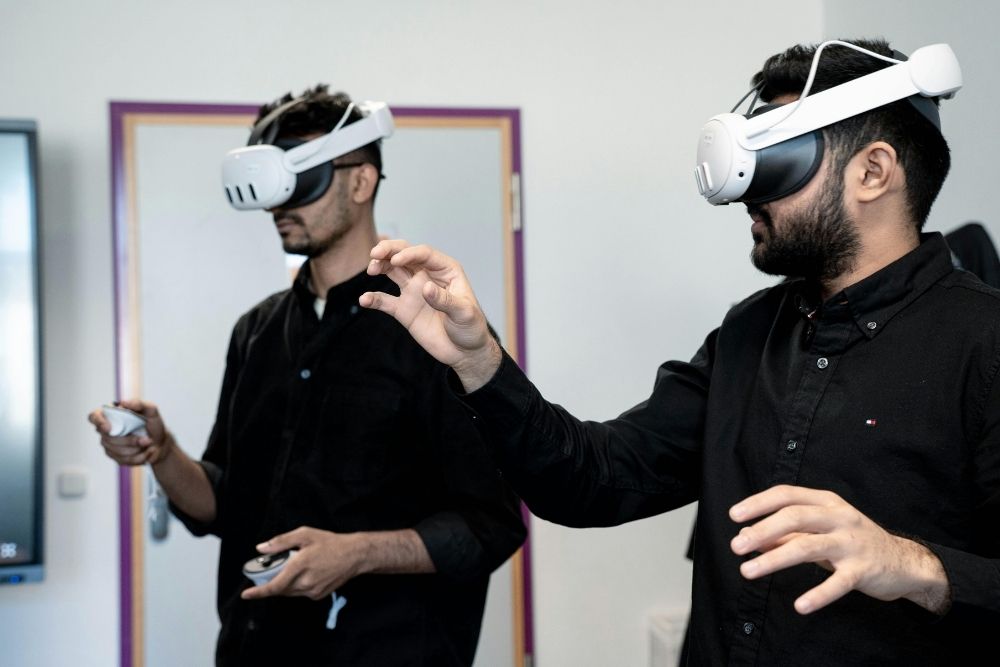
PEMANFAATAN VIRTUAL REALITY DALAM PENDIDIKAN PENERBANGAN
EVALUASI EFEKTIVITAS, TANTANGAN, DAN TRANSFER KETERAMPILAN MELALUI SYSTEMATIC LITERATURE REVIEW
DOI:
https://doi.org/10.24114/jmpsd.v3i3.70776Kata Kunci:
Virtual Reality, Pendidikan Penerbangan, Keterampilan Teknis, Keterampilan Non-Teknis, Systematic Literature Review, Transfer KeterampilanAbstrak
Penelitian ini bertujuan untuk mengevaluasi pemanfaatan teknologi Virtual Reality (VR) dalam pendidikan penerbangan, dengan fokus pada peningkatan keterampilan teknis dan non-teknis, tantangan implementasi, serta transfer keterampilan ke dunia nyata. Metode yang digunakan adalah Systematic Literature Review (SLR), yang mengumpulkan dan menganalisis artikel-artikel ilmiah terkait penggunaan VR dalam pelatihan penerbangan. Hasil penelitian menunjukkan bahwa VR efektif dalam meningkatkan keterampilan teknis, seperti navigasi pesawat dan pengendalian pesawat, serta keterampilan non-teknis, seperti pengambilan keputusan dan komunikasi tim dalam situasi darurat. Namun, tantangan utama yang dihadapi institusi pendidikan penerbangan adalah biaya dan infrastruktur, meskipun VR memberikan manfaat signifikan dalam hal fleksibilitas pelatihan dan pengurangan ketergantungan pada simulator fisik. Selain itu, meskipun VR meningkatkan keterampilan dalam simulasi, transfer keterampilan tersebut ke dunia nyata masih memerlukan evaluasi lebih lanjut. Kesimpulannya, VR memiliki potensi besar untuk mengoptimalkan pelatihan penerbangan, namun membutuhkan integrasi dengan pelatihan langsung di lapangan untuk memastikan transfer keterampilan yang efektif. Penelitian ini juga menyarankan penelitian lebih lanjut untuk mengembangkan model pelatihan VR yang lebih adaptif dan efektif dalam konteks pendidikan penerbangan.Referensi
Bernard, F., Bonnardel, X., Paquin, R., Petit, M., Marandel, K., Bordin, N., & Bonnardel, F. (2022). Digital simulation tools in aviation maintainability training. Computer Applications in Engineering Education, 30(2), 384–395. https://doi.org/10.1002/cae.22461
Bernard, F., Bonnardel, X., Paquin, R., Petit, M., Marandel, K., Bordin, N., & Bonnardel, F. (2022). Digital simulation tools in aviation maintainability training. Computer Applications in Engineering Education, 30(2), 384–395. https://doi.org/10.1002/cae.22461
Bornheimer, L. A., Li Verdugo, J., Humm, L., Steacy, C., Krasnick, J., Goldstein Grumet, J., Aikens, J. E., Gold, K. J., Hiltz, B., & Smith, M. J. (2024). Computerized Suicide Prevention Clinical Training Simulations: A Pilot Study. Research on Social Work Practice, 34(2), 182–193. https://doi.org/10.1177/10497315231161563
Masiello, I., Herault, R., Mansfeld, M., & Skogqvist, M. (2022). Simulation-Based VR Training for the Nuclear Sector—A Pilot Study. Sustainability (Switzerland), 14(13), 1–14. https://doi.org/10.3390/su14137984
Philip, N., Ali, K., Duggal, M., Daas, H., & Nazzal, H. (2023). Effectiveness and Student Perceptions of Haptic Virtual Reality Simulation Training as an Instructional Tool in Pre-Clinical Paediatric Dentistry: A Pilot Pedagogical Study. International Journal of Environmental Research and Public Health, 20(5). https://doi.org/10.3390/ijerph20054226
Rizvi, S. A. Q., Rehman, U., Cao, S., & Moncion, B. (2025). Exploring technology acceptance of flight simulation training devices and augmented reality in general aviation pilot training. Scientific Reports, 15(1), 1–16. https://doi.org/10.1038/s41598-025-85448-7
Somerville, A., Lynar, T., Joiner, K., & Wild, G. (2024). Use of Simulation for Pre-Training of Drone Pilots. Drones, 8(11), 1–14. https://doi.org/10.3390/drones8110640
Strand, A., Gorton, P. R., & Brathen, K. (2025). Modeling Air Combat Behavior for Simulation-Based Pilot Training: A Survey of Machine Learning Approaches. IEEE Access, 13(June), 113666–113685. https://doi.org/10.1109/ACCESS.2025.3580279
Unduhan
Diterbitkan
Cara Mengutip
Terbitan
Bagian
Lisensi
Hak Cipta (c) 2025 Rahmat, Hasan Maksum, Dony Novaliendry

Artikel ini berlisensiCreative Commons Attribution-ShareAlike 4.0 International License.
Authors who publish with this journal agree to the following terms: (1) Authors retain copyright and grant the journal right of first publication with the work simultaneously licensed under a Creative Commons Attribution-ShareAlike 4.0 International License (CC-BY-SA) that allows others to share the work with an acknowledgment of the work's authorship and initial publication in this journal; (2) Authors are able to enter into separate, additional contractual arrangements for the non-exclusive distribution of the journal's published version of the work (e.g., post it to an institutional repository or publish it in a book), with an acknowledgment of its initial publication in this journal; (3) Authors are permitted and encouraged to post their work online (e.g., in institutional repositories or on their website), as it can lead to productive exchanges, as well greater citation of published work (See The Effect of Open Access).