Etnomatematika Ombus-Ombus dan Lemang sebagai Sumber Belajar Kontekstual Bangun Ruang Sisi Lengkung di Sekolah Dasar
DOI:
https://doi.org/10.24114/jmpsd.v4i2.78058Keywords:
Curved-Surface Solids, Elementary Mathematics Learning, Ethnomathematics, Lemang, Ombus-OmbusAbstract
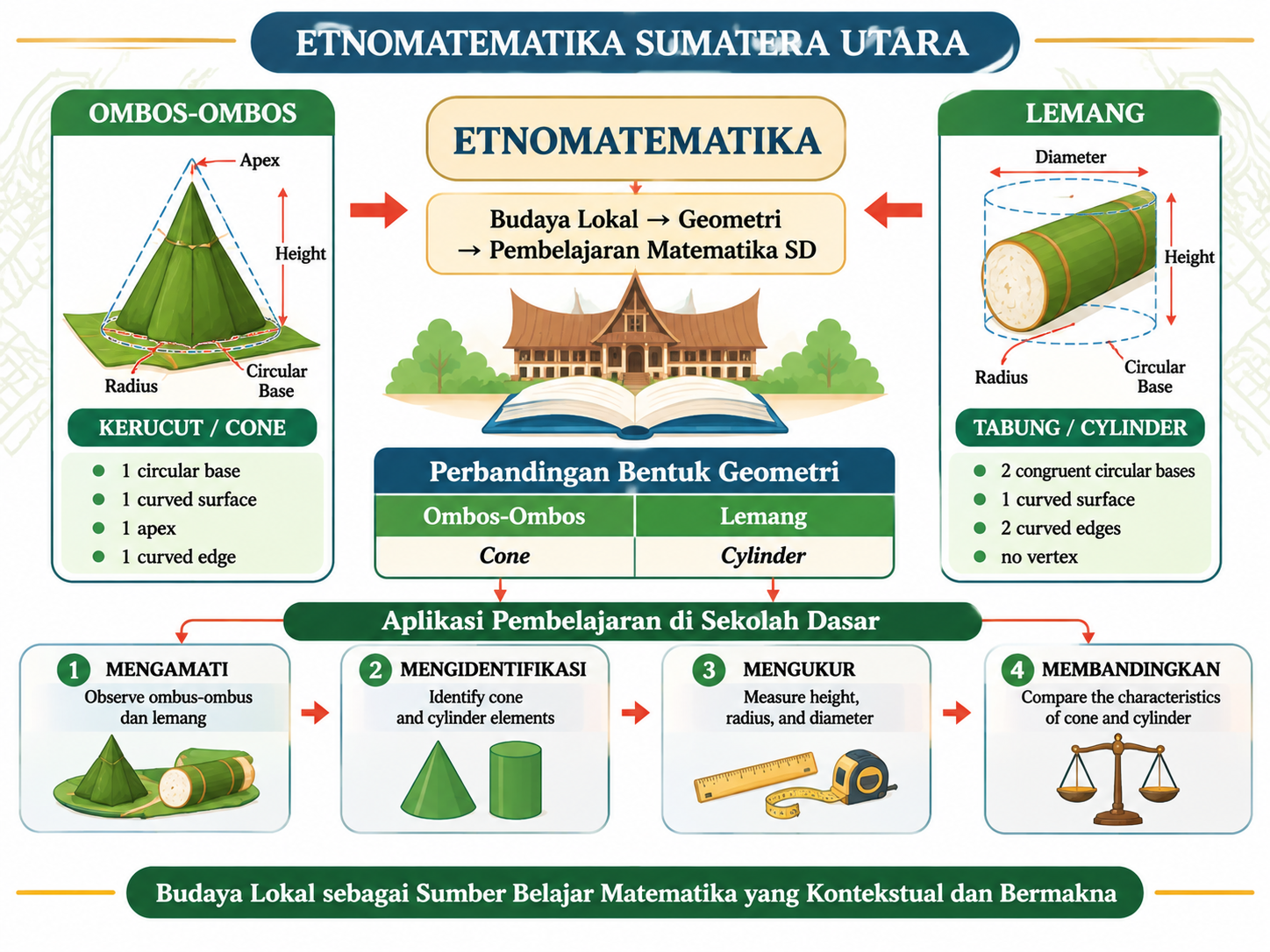
Elementary school students often perceive curved-surface solids as an abstract topic, even though the concepts are present in everyday life and local culture. This study aims to examine the ethnomathematical elements in two traditional foods of North Sumatra, namely ombus-ombus and lemang, as a contextual learning resource for the properties of curved-surface solids in elementary school. The study used a qualitative approach with a literature review of scientific journal articles, analyzed through data reduction, data display, and conclusion drawing. The findings show that ombus-ombus resembles a cone with one circular base, one curved surface, and one apex, while lemang resembles a cylinder with two congruent circular bases and one curved lateral surface. The shape of ombus-ombus is influenced by how the banana leaf is folded, and some studies report square pyramid elements, so both foods are better regarded as contextual models of solids. Teachers can use both foods to introduce the elements of solids, the measurement of height, radius, and diameter, and the concepts of surface area and volume. Their use has the potential to make geometry learning more concrete and meaningful and to foster students’ appreciation of regional culture.
Downloads
References
Amelia, R., Ridwan, M. R., & Hardiansyah, F. (2025). Ethnomatematics-based geometry learning in elementary schools through traditional food media. El Midad, 17(1). https://doi.org/10.20414/elmidad.v17i1.13335
Azurah, M. T. Y., & Maysarah, S. (2024). Exploration of ethnomathematics in traditional Javanese cakes. Unnes Journal of Mathematics Education, 13(3), 220–230. https://doi.org/10.15294/ujme.v13i3.15812
Dalimunthe, R. R., Sasongko, D. F., & Rofiki, I. (2022). Etnomatematika pada kue tradisional Asahan sebagai sumber belajar matematika. Galois: Jurnal Penelitian Pendidikan Matematika, 1(1), 17–26. https://doi.org/10.18860/gjppm.v1i1.1072
Fauziah, S., & Zaenuri. (2025). Ethnomathematical exploration of Tegal traditional food as source of contextual problems in problem-based learning model. Unnes Journal of Mathematics Education, 14(2), 135–143. https://doi.org/10.15294/ujme.v14i2.30550
Febrianti, N. F., & Indrawati, D. (2021). Eksplorasi geometri pada jajanan tradisional di Lamongan sebagai implementasi etnomatematika di sekolah dasar. Jurnal Penelitian Pendidikan Guru Sekolah Dasar (JPGSD), 9(1), 1530–1541.
Hasibuan, H. A., & Irvan. (2025). Ethnomathematics exploration of making traditional ombus-ombus cake typical of North Tapanuli as a source of mathematics learning. Mathline: Jurnal Matematika dan Pendidikan Matematika, 10(1), 85–95. https://doi.org/10.31943/mathline.v10i1.717
Kabuye Batiibwe, M. S. (2024). The role of ethnomathematics in mathematics education: A literature review. Asian Journal for Mathematics Education, 3(4), 383–405. https://doi.org/10.1177/27527263241300400
Kementerian Pendidikan, Kebudayaan, Riset, dan Teknologi. (2022). Capaian pembelajaran pada pendidikan anak usia dini, jenjang pendidikan dasar, dan jenjang pendidikan menengah pada Kurikulum Merdeka (Keputusan Kepala Badan Standar, Kurikulum, dan Asesmen Pendidikan Nomor 008/H/KR/2022).
Khairum, D., Sianipar, D. M., & Wijaya, Y. L. (2025). Etnomatematika kearifan lokal makanan khas Sumatera Utara: Eksplorasi bentuk-bentuk bangun ruang sisi lengkung. Jurnal PRIMED: Primary Education Journal, 5(3), 1093–1101. https://doi.org/10.36636/primed.v5i3.6004
Kitchenham, B., & Charters, S. (2007). Guidelines for performing systematic literature reviews in software engineering (EBSE Technical Report EBSE-2007-01). Keele University and University of Durham.
Kyeremeh, P., Awuah, F. K., & Dorwu, E. (2023). Integration of ethnomathematics in teaching geometry: A systematic review and bibliometric report. Journal of Urban Mathematics Education, 16(2), 68–89. https://doi.org/10.21423/jume-v16i2a519
Mailani, E., Kharismayanda, M., Saragih, E. K., Ginting, F. M. B., Sitinjak, F., & Tarigan, P. S. B. (2024). Penerapan bangun ruang melalui makanan khas Sumatera Utara. JICN: Jurnal Intelek dan Cendikiawan Nusantara, 1(5), 6414–6423. https://jicnusantara.com/index.php/jicn
Mailani, E., Kharismayanda, M., Siregar, A., Siregar, A. D. Y., Siregar, F. H., & Melati, S. A. (2025). Etnomatematika makanan tradisional Sumatera Utara di pasar-pasar tradisional dengan berbagai bangun ruang. JCRD: Journal of Citizen Research and Development, 2(1), 444–452.
Naibaho, T., Sinaga, S. J., Simangunsong, V. H., & Sihombing, S. (2022). Eksplorasi kue tradisional Batak Toba terhadap konsep geometri. Jurnal Pendidikan Matematika: Judika Education, 5(1), 42–48. https://doi.org/10.31539/judika.v5i1.3652
Nanda, M. A., Luthfany, Z. A., & Putri, R. D. P. (2026). Implementation of ethnomathematics in teaching geometry concepts in elementary school: Systematic literature review. Ar-Riyadhiyyat: Journal of Mathematics Education, 6(2), 91–99. https://doi.org/10.47766/arriyadhiyyat.v6i2.6874
Nengsih, R., & Marlia, R. (2024). Analisis etnomatematika pada makanan tradisional Minangkabau. Jurnal Insan Peduli Pendidikan (JIPENDIK), 2(1), 41–48. https://ejournal.lppinpest.org/index.php/jipendik
Nurdin, H., Nur, F., & Yuliany, N. (2025). Analisis etnomatematika pada kue tradisional Bugis dan penerapannya dalam pembelajaran geometri. Jurnal Derivat, 12(1), 10–24.
Octaviani, A., & Mariana, N. (2023). Eksplorasi etnomatematika pada kue lapis legit dengan konsep geometri volume bangun ruang kelas V sekolah dasar. Jurnal Review Pendidikan Dasar: Jurnal Kajian Pendidikan dan Hasil Penelitian, 9(1), 43–47. https://doi.org/10.26740/jrpd.v9n1.p43-47
Pathuddin, H., Kamariah, & Nawawi, M. I. (2021). Buginese ethnomathematics: Barongko cake explorations as mathematics learning resources. Journal on Mathematics Education, 12(2), 295–312. https://doi.org/10.22342/jme.12.2.12695.295-312
Popay, J., Roberts, H., Sowden, A., Petticrew, M., Arai, L., Rodgers, M., Britten, N., Roen, K., & Duffy, S. (2006). Guidance on the conduct of narrative synthesis in systematic reviews: A product from the ESRC Methods Programme. Lancaster University.
Priyatna, S., & Utami, N. W. (2023). Ethnomathematics-based student worksheets: Yogyakarta traditional foods as a means to learn solid geometry. Instructional Media for Mathematics, 1(1), 19–29.
Ramadhani, R., Prahmana, R. C. I., Soeharto, & Saleh, A. (2024). Integrating traditional food and technology in statistical learning: A learning trajectory. Journal on Mathematics Education, 15(4), 1277–1310. https://doi.org/10.22342/jme.v15i4.
Raydani, E., Sutopo, Y., Subali, B., & Ellianawati, E. (2026). Pola integrasi budaya dalam pendekatan culturally responsive teaching: Kajian literatur (2010–2025). JS (Jurnal Sekolah), 10(2), 363–375. https://doi.org/10.24114/ma42b329
Ritonga, S. Y. K. (2024). Exploration of ethnomathematics in traditional Lebaran food in Labuhanbatu. Journal of Mathematics Education and Application (JMEA), 3(3), 109–122. https://doi.org/10.30596/jmea.v3i3.20551
Sitorus, N. A., Simangunsong, E. M. S., Sagala, T. D., Rajagukguk, C. M., Sinabuttar, M., Sidadolog, B., & Aritonang, M. H. (2026). Eksplorasi etnomatematika pada lemang dan saluang di Sumatera Barat. SCIENCE: Jurnal Inovasi Pendidikan Matematika dan IPA, 6(3), 2235–2246. https://doi.org/10.51878/science.v6i3.12992
Snyder, H. (2019). Literature review as a research methodology: An overview and guidelines. Journal of Business Research, 104, 333–339. https://doi.org/10.1016/j.jbusres.2019.07.039
Sulistyowati, E., & Mawardi, D. N. (2023). The effectiveness of ethnomatematics based learning on mathematics ability of elementary school students: A meta-analyis study. Al-Bidayah: Jurnal Pendidikan Dasar Islam, 15(1), 1–26. https://doi.org/10.14421/al-bidayah.v15i1.879
Sulistyowati, E., Sugiman, & Sayuti, S. A. (2024). Meta-analysis study of the effectiveness of the ethnomathematical approach on students’ achievement. Pegem Journal of Education and Instruction, 14(1), 197–204.
Thomas, J., & Harden, A. (2008). Methods for the thematic synthesis of qualitative research in systematic reviews. BMC Medical Research Methodology, 8, Article 45. https://doi.org/10.1186/1471-2288-8-45
Xiao, Y., & Watson, M. (2019). Guidance on conducting a systematic literature review. Journal of Planning Education and Research, 39(1), 93–112. https://doi.org/10.1177/0739456X17723971
Zumara, N. S., Siregar, E., Sarifah, I., & Rahmadi, I. F. (2026). Visual and interface design mechanisms: Systematic review of ethnomathematics media bridging culture and mathematics. Jurnal Elemen, 12(3), 790–808. https://doi.org/10.29408/jel.v12i3.34264
Published
Issue
Section
License
Copyright (c) 2026 Grasyela Sihombing, Gres Silvia Manurung, Juwita Fadilla, Ria Lumbangaol, Ruth Christine Angelitta Br Togatorop

This work is licensed under a Creative Commons Attribution 4.0 International License.
Authors who publish with this journal agree to the following terms:
Authors retain copyright and grant the journal right of first publication with the work simultaneously licensed under a Creative Commons Attribution 4.0 International that allows others to share the work with an acknowledgement of the work's authorship and initial publication in this journal.
Authors are able to enter into separate, additional contractual arrangements for the non-exclusive distribution of the journal's published version of the work (e.g., post it to an institutional repository or publish it in a book), with an acknowledgement of its initial publication in this journal.
Authors are permitted and encouraged to post their work online (e.g., in institutional repositories or on their website) prior to and during the submission process, as it can lead to productive exchanges, as well as earlier and greater citation of published work.